Monday, March 23, 2015

PRAN KISHORE : A LIVING LEGEND WHO PIONEERED RADIO DRAMAS IN KASHMIR


PRAN KISHORE KAUL (BORN 1925): A MULTIFACETED PERSON WHO PIONEERED RADIO DRAMA IN KASHMIR


This author  vividly remembers how food was served to us at 8.30 pm and my mother would finish everything by 9.15 pm. Thereafter everyone in our family kept glued to the radio in hush silence waiting till 9.30 pm when we would hear something like this:-


“ Ye chhu Radio Kashmir Srinagar. Raaetch henz saad’a nuv bajeiye . Booziv drama’ lala joo and sons’. Tehreer Ali Mohammad Lone ta peishkush Pran Kishore .” or "This is Radio Kashmir Srinagar . It is 9.30 pm now. Tune in to our drama ‘Lala Joo And Sons’ scripted by Ali Mohammad Lone and produced by Pran Kishore”. Some notable and very popular plays produced by Pran Kishore could be listed as under:-


 (1) ‘Vyaathh rooz pakaan’ ( a drama series for which Akhtar Mohi ud Din, Ali Mohammad Lone and Som Nath Zutshi wrote powerful radio dramas. Ali Mohammad Lone’s drama for this series was selected in the National Drama Festival and won the first prize )

(2)’ Vaitaal Pacheesi’ ( From Kathaa Sarit Saagar translated by Ali Mohammad Lone. Pran Kishore acted as Vaitaal )

(3) ‘Bombur Ta Yemberzal’ ( opera written by Dina Nath Nadim ) 

(4)’Dr Faustus’(translated by Rehman Rahi. Pran Kishore acted as Dr Faustus )

(5) ‘Vitasta’ ( opera by Dina Nath Nadim. The stage adaption was also directed by Pran Kishore Kaul ) 

(6) ‘Lala Joo and Sons’ ( written by Ali Mohammad Lone )

(7) ‘Aadam Chhu Ajab Zaat’ ( written by Akhtar Mohi ud Din )

(8) ‘Yeli Vattan Chhu Khuur Iwaan’ ( scripted by Hari Krishen Kaul )

(9) ‘Vaen Kaemsinz Vaer Chhi’ and’’ Harud’ ( scripted by Dr Shanker Raina )

(10) ‘Myon Marun,’Buss Akh Tamaah’ and ‘D’aan Tha’r‘ ( Scripted by Bansi Nirdosh )

(11) ‘Agar Aash Sorie’, ‘Kaend Sahraav’,’ Jheel Bulaa Rahi Hai’, ‘Aadam Hawa Ta Iblees’, ‘P’asha kiss Vatchhus Tal’ and ‘Myani Jigreikk Daadi Voath’ ( scripted by Ali Mohammad Lone )

(12 ) ‘Buut Ta Bulldozer’ ( scripted by G R Santosh )

( 13) ‘Shuhul Naa’r , ‘Taent Kur’ and’ Kaejj Raat’ ( scripted by Sajood Sailani )

(14) ‘Vijvaav’ ( scripted by Som Nath Zutshi )


The radio plays that he produced or directed , broadened the listener base of Radio Kashmir Srinagar. The dramas scripted by  Amar Malmohi, Shamas ud din Shamim, Rattan Lal Shant, Autar Krishen Rehbar, Shabnam Qayoom, Moti Lal Kemu and many more playwrights were also produced or directed by Pran Kishore for Radio Kashmir. It is practically impossible to record all plays that he either produced or directed or wherein he acted. The list could be endless.

On account of his exceptional command over English, Hindi, Urdu and Kashmiri languages, Pran Kishore also translated many plays from English, Urdu and Hindi to Kashmiri and ensured their broadcast from Radio Kashmir, Srinagar. Many plays produced by him for Radio Kashmir Srinagar won awards in the National Radio Drama festivals. He even translated Stein’s Rajtaringini and presented it as a radio feature. Many radio artists have confirmed to this author that he was always present during the recording and rehearsals of his plays. He would meticulously record every dialogue to its perfection in a professional environment. He would not allow any side talks and nobody would dare to disturb his work not even his close associates like Kedar Sharma, P L Razdan and M L Kuchroo. Jai Kishen Zutshi, who was also associated with radio dramas and who later shifted to Doordarshan, was trained by Pran Kishore .


His radio features on saint poetess ’Lal Ded’ and the tallest saint of Kashmir's Reshi order fondly known as  ‘Nund Ryosh’, remain unmatched to this day in terms of production, script and presentation. For the ‘Lal Ded’ feature, he sought assistance from Prof Jay Lal Kaul and Master Zinda Kaul. Both features were broadcast through various AIR stations in India. ‘Aab Ta Hayaat’ ( Water And Life ) is a radio feature that won him national and international fame. Not many of us know that it was presented before a mammoth gathering in Milan, Italy. This Radio feature was written and presented by Pran Kishore Kaul in his unique and impressive voice. Pran Kishore's voice is an amalgamation of rainbow colours, thundering clouds and whistling breeze. Sweet-scented all over, soft when needed and imposing when required. This voice was dubbed for many characters in the Kashmiri feature film’ Maenzraat’. The Kashmiri version of this film was directed by Pran Kishore Kaul. This feature film received ‘Silver Peacock’. The stage adaptation of poet Dina Nath Nadim’s opera ‘Bombur ta Yemberzal ‘ was superbly directed by him and shown to the Russian delegation in December 1955 in Srinagar. The Russian delegation included Marshal Bulganin and Nikita Khrushchev. He also directed the stage adaptation of ‘Vitasta’ opera scripted by Dina Nath Nadim. The opera was performed in various cities of the country and it won rave reviews in print media everywhere. So happened with 'Piya Baaj Pyala ‘ and ‘ Himalaya Ke Chashme’ that he directed. He started the annual ‘Jashn e Tamseel’ festival for radio dramas. Many Kashmiri playwrights touched heights of popularity through the radio plays that he produced or directed. Many Kashmiri radio dramas featured in the Akaashwani awards. As a presenter, he is endowed with a rich imagination to do anything and everything that is required to create a good drama, a good script, and an unsurpassed production. A perfectionist to the core, he remains a nice and cultured human being for all who happen to come close to him.


Writing is another field wherein Pran Kishore Kaul has excelled. His Kashmiri novel. ‘Sheen Ta Vatta Podh’ won him the best book award from the Jammu And Kashmir Academy of Art, Culture And Languages. This novel also won him the prestigious Sahitya Akademi Award. This novel is based on Gujjars and Bakerwals with Characters like Raj Wali Khan, Reshma Qamroo, Peera, Laali, Maaja, Nooran Bibi, Laal Khan, Mastaan Khan and Zorawar. Raj Wali Khan and Reshma are central characters in this wonderful novel. If you read the novel, you are bound to get surprised as to how he acquired such in-depth knowledge of the life, customs and traditions of Gujjars and Bakerwals. Balraj Sahni, his friend and well-known Hindi cinema actor was interested in making a film on this novel and also wanted to play the role of Raj Wali Khan. He also authored some more books like, Gul Gulshan Gulfaam, The Zoon of the Saffron Fields, Radio Kashmir and My Days in Broadcasting, ‘Sheen- Snow And The Bridle Path and a monograph on his lifelong friend and artist G R Santosh.


Pran Kishore Kaul remains a school of excellence in many areas like broadcasting, radio drama, stage acting, scriptwriting, cinematography, production, direction, special effects, film acting, painting, and writing. His affable mannerism, crystal-clear integrity and dynamic outlook endeared him to a vast circle of friends that included Prabhat Mukerji, and actor Tom Alter. He is a connoisseur of music, dance and poetry. Name any segment of fine arts, literature and mass communication, Pran Kishore has put his imprints and added his contribution directly or indirectly. Pran Kishore could have been another Abbas Kiarostami had he moved out and joined films. Like Kiarostami, the celebrated filmmaker from Iran, Pran Kishore’s scripts, line of direction and presentation are always rooted in the ground and the content has something deeper to convey. And had he had done so, a generation of stage artists, writers and actors from Kashmir, whom he helped to grow, would have been denied his help and guidance.

Post-retirement, Pran Kishore Kaul scripted some popular TV serials like GUL GULSHAN GULFAAM (based on his Novel by the same title), SAAYE DEVDAAR KE and JUNOON apart from many other assignments that he completed to perfection. He also set up his own production house known as PRAGAASH PRODUCTIONS. Along with his dance-drama troupe, he went to many places including Hong Kong spreading the fragrance of the grand culture of Kashmir. A galaxy of dancers, singers and musicians from Kashmir were associated with this production troupe prominent being Ali Mohammad Sheikh, Kishen Ji Langoo, Mrs Prerna Jailkhani, Dalip Langoo, Saleha and many more. About Gul Gulshan Gulfam, Prem Krishen  ( son of veteran actor Prem Nath and co-producer of the TV serial ) says this:-

"My father desired to make something based on Kashmir which he loved intensely. And we made Gul Gulshan Gulfam. Pran Kishore wrote a wonderful script that gave a total feel of Kashmir. He also made some good suggestions that added to the popularity of the serial.”


                                        .    


   ( Pran Ji shooting Kashmiri feature film Maenzraat at some outdoor location near Tangmarg  Kashmir )


 ( A memorable photograph of  The Radio Kashmir Team .. Pran ji, Bashir Butt , Pushker Bhan , Quaiser Qalandhar ,Ali Mohd lone , Manohar Prothi, Jagan  Nath Saqi ,Kamal Ahmed Siddique, Som Nath Sadhu , Mohd sultan Pandit and many more  )


                                  ( Pran ji with GyanPeeth Awaedee Kashmiri Poet Prof. Rehman Raahi  )
                    ( Pran ji with Pushkar Bhan  a talented actor and writer who wrote the most popular  Hero Machama and Sindhbaad Machama series for the Radio Kashmir   )
                                                                       
                                                        ( Pran Ji with Ustaad Bismillah Khan )                   

                                                                             
          ( L To R Pran Kishore , His daughter , Broadcaster Uma Khosla and Pran ji's wife Late Shanta kaul )
                                                                         
                                                              ( Pran Kishore )
  Remembering his childhood   days  Pran Kishore Kaul informs this:-

“” In 1943, a play named NEELAM was staged in S P College in which I and Qaiser Qalandhar acted . For this play , Prof.Raja Mohd Maqbool Changed my name from Pran Nath Koul to Pran Kishore . That day onwards , I remained Pran Kishore . I was born at Mallapora,  Habba Kadal in  Srinagar  city . I have clear memories of Kashmir during those days. The Jabri schools, poverty , simplicity and then an aircraft hovering over the sky and landing in Srinagar . Kashmiris coming out on roads and looking towards the sky . The funny Ladishaah song created for this strange phenomenon happening over Kashmir’s sky ,

' Havaai jahaaz yeli aav Mulk e Kashmir 
Yimuvv Vuchh timav korr Toba Taqseer
Godeineythh khoat taathh Taraakh Wazir 
Athhuss kyaathh Aaeissus Natchaan jejeer' 

“ When the first aircraft flew over Kashmir ,
Every one who saw it exclaimed “Oh God ! save us “
It was Taraak wazir who first boarded this aircraft 
With a dancing Hookah in his hand.|”

 I vividly remember the day when electric Bulb was switched on for the first time in our house in Srinagar city and the benefits of electricity were made known to us .The electric power for the same was generated by Mohra Power  House .Prior to that , Maharaja’s Palace was only connected to electric power .There used to be a turbine based Mini Power House on Jhelum bank near the present day old secretariat that would supply electricity to Maharja’s Palace .This place is still known as Bijli Ghar. Present generation can not visualize how happy people were with this electric connection that was provided to them.

People had no wrist watches or clocks . Just the deafening sound of a canon fired from Hari Parbat fort made you to believe that it was 12 noon. At 9 pm ,the city dwellers were informed about the time when the electricity was slowly dimmed and finally switched off in the entire city . It was immediately restored .I vividly remember how for the first time , city dwellers were supplied water from Harwan reservoir through a well laid out system of pipes .Water Works Department was started during the rule of Maharaja Partap Singh and it took them some years to complete this task.Once the work with regard to building of the reservoir and laying of the pipes in the city was completed , an estimate about the expenditure was provided to Maharaja . The Maharaja was also advised by the British engineer incharge to levy tax on the people of the city and recover the expenditure . To this suggestion Maharaja replied .' Water is God’s gift to humanity . You mean I should sell this and earn Money ? No .' And free came the drinking water to the city dwellers for the first time through taps from Sarbandh at Harwan."


( L to R G R Santosh , Pran kishore and Ali Mohd lone )
( Sh M S Pandit IAS  looking at Pran ji's paitings )
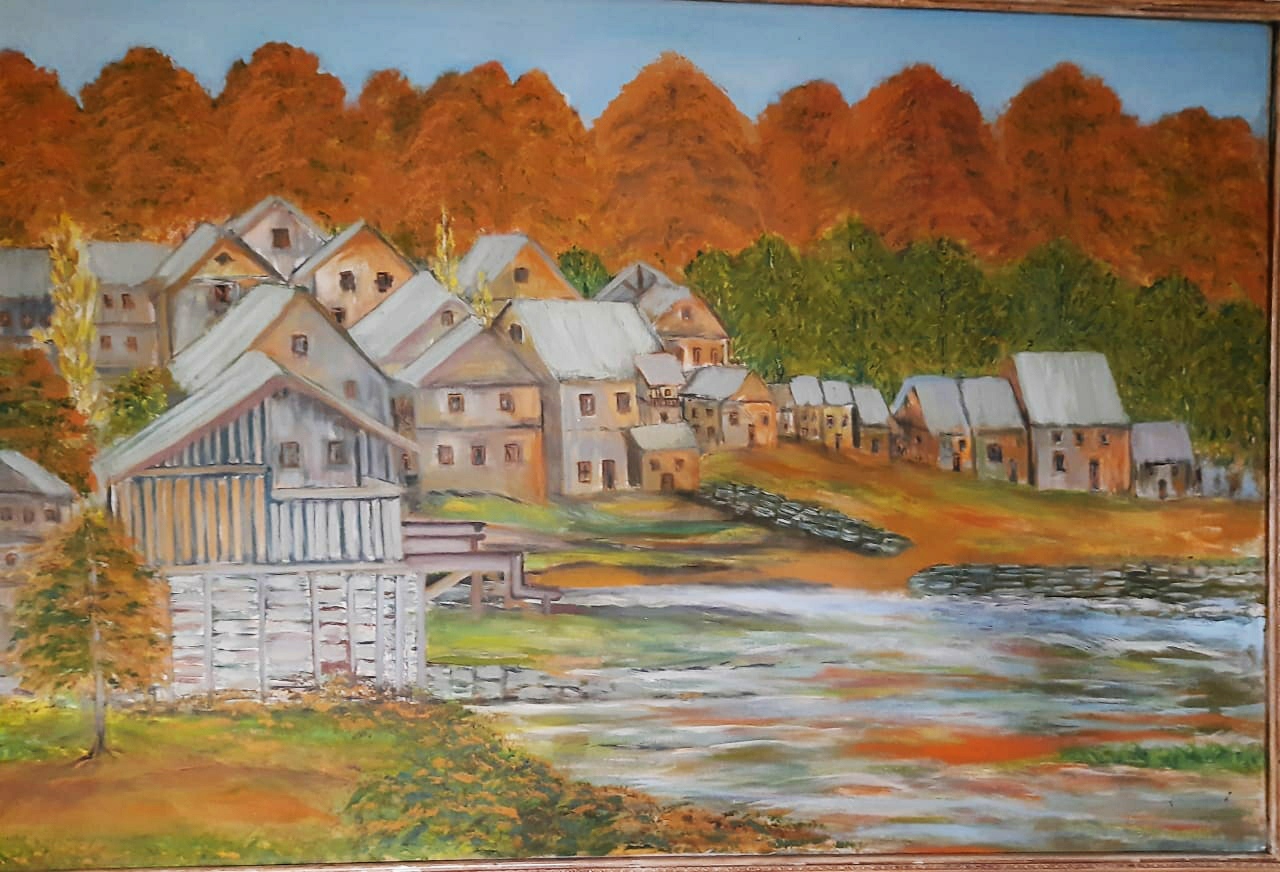
                                                          ( A painting by Pran Kishore Kaul )
                                                                ( A painting by Pran Kishore Kaul )
                                                           ( A painting by Pran Kishore Kaul)


                                          ( Above 8 sketches done by Pran Kishore Kaul )


Not many of us know that Pran Kishore Kaul is a good painter. To this author, he said:-


 “Once Shanta Ji, my wife told me to exit from all activities and focus only on painting. It couldn't be that way as other things were destined to happen even though the painting had been my first love. If anyone asks me what gives me more satisfaction, I would straightway say painting. I also like to enter the kitchen and cook at times. Yes, the non-vegetarian dishes of Kashmiris. Painting could be a result of my close association with G R Santosh. I tell you Santosh would also cook Kashmiri dishes and feel proud in entertaining his friends. Ali Mohammad Lone, I and Santosh would often cook and eat together Kashmiri non-vegetarian dishes. We would do it on many Sundays in Bani Prassun Batacharya’s government quarter. Bansi was a sculptor who was also a technical expert engaged by the Government of J&K”


A widely travelled man, Pran Kishore remains an encyclopedia of knowledge on the art, culture and history of Kashmir. Presently settled in Pune, he leads a somewhat lonely life after the death of his wife and lifelong companion, Shanta Kaul. Shanta ji was also a broadcaster par excellence. A documentary on his life and work was produced by Sahitya Akademi recently. He has also been conferred the Padama-shri award in 2018. When this author spoke to him some days back ( in March 2023 ), he was busy editing his documentary on Saint Gopinath Ji of Kashmir. He loves Ghalib and Rumi and quotes them often in his conversation. I end this brief write-up on Pran Kishore Kaul with two lines from Rumi’s verse:-

 “Goyand ke Ishq aghebat taskin ast

Aval shor ast va aghebat tamkin ast”……..Rumi


(They say you will find relief at last in love

First, it’s bitter, but finally, it’s sweet.)


( Avtar Mota )                                       


Creative Commons LicenseCHINAR SHADE by Autarmota is licensed under a Creative Commons Attribution-Noncommercial-No Derivative Works 2.5 India License.
Based on a work at http:\\autarmota.blogspot.com\.

Tuesday, March 17, 2015

PANDIT LABHU RAM JOSH " MALSIYAANI " AND HIS POEM ON KASHMIR.


PANDIT LABHU RAM JOSH MALSIYAANI ( 1882-1976)

" Bahar e ulfat mein ho gayaa jo gark
Chashmaa e zindagi mein jaa niklaa…"
( Josh Malsiyaani )
He who drowned himself in the sea of love ,
Made his appearance in the  water spring of Life  ….

Met a relation of  Balmukand Arsh Malsiyaani son of  Pandit Labhu Ram Josh Malsiyaani recently .Both father and son were well known Urdu  poets from Punjab . Came to know some more facts about Pandit Labhu Ram Josh . Some are shared as under:-

Josh Sahib always wore simple clothes. A Dhoti , Kurta ,  Desi Jooti and a Punjabi Pugrree was all that he wore during summers . In winter season  he would  always wear a black coat over a shirt.  He looked like a perfect farmer who had nothing to do with poetry. Though  his son  Balmukand Arsh Malsiyaani  was a senior officer with Govt of India , Josh never changed his living style when he lived with his son. He ate Moong   Daal  and Chapaati , never touched  liquor and was a vegetarian all along his life .  He smoked  Hookah which he carried along with him  while he was travelling away from his home.Quite often, during a Mushaira , when Hookah was not  permitted on the stage , he asked for the cheapest  "Red Lamp"  cigarettes .Simple dress and simpler  eating habits remained  his lifelong companions .
His needs in life were almost nil   and that is why ne never complained of his poverty  .He never got excited by praise in Mushairas but was always supportive of new and talented poets .He spent his time either playing chess or writing poetry .

Born in village Malsian near Nakodar( district Jalandhar) , Labhu Ram Josh belonged to a family of Saraswat Brahmins that  earned livelihood from trading in Gurr or Jaggery . Malsian is a  village located in Shahkot Tehsil of Jalandhar district in Punjab with a population about 2000.

Josh''s father drank, ate and enjoyed his  own life at Peshawar were he had set up his JAGGERY business believing that the family back home  would live on charity or help from relatives . On account of this  irresponsible  attitude of his father, the family had to live in extreme poverty .Sometimes  some financial  help  or  support  came from some close relatives of his mother. Josh was attached to his mother since his childhood.

Josh felt disgusted with trading profession as his father suffered losses and the family came under heavy debt. . His father drank himself to death .After the death of his father , Josh joined as a  Persian cum Urdu teacher in a primary school to earn something for the family that was almost starving .  Though a brilliant boy in his school  , Josh  could not continue his studies and learn English language  due to  unforeseen  family circumstances . He,  however completed  "Munshi Fazil" and Adeeb Faazil " degrees  .He served as  teacher   in  Nakodar  town near Jalandhar for  almost all his life. In thought and deeds,he remained a Gandhian all along his life.

In 1940,he published his poetic collections in a book titled " BAADA E SARJOSH "

It is also a fact that he never encouraged  his son Balmukand Arsh for writing Urdu poetry.  Amongst his pupils , Sahir Hoshiarpuri  from Punjab carried forward his style . " Kaun Kehtaa hai Mohabbat ki Zubaan hotii hai.. Yeh haqeeqat to Nigaahon se Bayaan Hotii hai " is a popular gazal of  Sahir Hoshiarpuri sung by late  Jagjt Singh. Naresh Kumar ' 'Shaad 'was another illustrious disciple of Josh Malsiyaani.
 
 Josh  had taken lessons from Daag Dehlavi whom he met in 1902 . later he   wrote poetry  in Daag’s style . He belonged to Delhi School of urdu poetry . I quote some couplets 

(Na- shagufta hi rahi dil ki Kali 
Mausam e gul baarhaa aataa rahaa ..)

 
( Maut ki zadd se bach gaya jo koyee
Uss ko umer e daraaz ne Maara )

( Balaa se koyee haathh maltaa rahay
Teraa husn saanchay mein daltaa rahay )

( karuun sharah e junoon kyonkar khiradmandon ki mehfil mein
Yeh woh nuqte hain jin ko ahle daanish kam samjhatein hain)

( Teray andaaz par umar e ravaan kuchh shaq guzartaa hai 
Liye jaati hai tu mujh ko kidhar aahistaa Aahistaa )

( Zindagi kuchh bhi nahin soz e mohabbat ke bagair 
aag uss dil ko lagay jo nahin khwahaan tera )

( Gilaa na meharbaani ka to sab se sun liya tum ne 
Tumhaari meharbaani ki shikaayat hum bhi rakhtein hain)

(Jab duvayein bhi kuchh assar na karein
Kya karein sabr hum agar na karein
Dastaan khatm ho hi jaayegi
Aap qisse ko mukhtsar na karein)

His poem "NAYA KASHMIR "remains amongst the finest poems written on Kashmir..I quote some lines..

Aey tamaashaai bahut kuchh tuune ki sair e jahaan 
Ab zara Kashmir mein aa kar nayaa kashmir dekh

Eik muddat se hai chashm e gair lalchaai huyii
Be gunaahi ki khataa masoom ki taqseer dekh.

Sohbat e sheikh o birahman par nazar kar gaur se,
Aarti ko hamnawaa e naraa o Taqbeer dekh..

Ranjh o gham mein dekh iss ka hausalaa iss ka jigar,
Aafaton mein iss ke isstaqlaal ki tasveer dekh..

Tuune har taameer mein takhreeb dekhi hai magar,
Aey tamaahsaai yahaan takhreeb mein taameer dekh..


Josh Malsiyani’s poetry and contribution finds place amongst fifty-two poets whose lives and works have been discussed in Malik Ram's  monumental work - Tazkirah e muasireen, Vol.4. Sahitya  Akademi has published a beautiful monograph  on Josh Malsiyaani. The monograph has been  authored by Bhupendra Parihar. Josh was decorated with Padamshri by Government of India.The University of California in the US has digitalised his work "Maktubat-i Josh Malsiyani banam Raza". In Punjab, he earned a fond name "Nakodar Ka Sant".

( Avtar Mota )

Creative Commons LicenseCHINAR SHADE by Autarmota is licensed under a Creative Commons Attribution-Noncommercial-No Derivative Works 2.5 India License.
Based on a work at http:\\autarmota.blogspot.com\.

Saturday, March 14, 2015

KASHMIRI MEHNDIRAAT ...A SPECTACLE OF HENNA , SINGING AND DANCE


( Mehndi or Henna being offered to guests  during Mehndiraat function in a Kashmiri  Pandit family )
                                                                                         (Photo Avtar Mota )


KASHMIRI MEHNDIRAAT ...A SPECTACLE OF HENNA, SINGING AND DANCE


Mehndiraat happens to be the most important function preceding the actual wedding in a Kashmiri marriage ceremony. Mehndiraat function of Pandits and Muslims of Kashmir has a profound similarity of sentiment that runs over and above the religious divide. It is a symbol of shared culture, tradition and mother tongue. 


Walter Lawrence in his book ‘THE VALLEY OF KASHMIR “ mentions that apart from the marriage ceremony, Mehndi raat function was held by Kashmiris Pandits and Muslims on Mundan ( Zarkaasaai), Mekhla (Yageopavit ) and Khatanhaal ( circumcision ceremony ). In all these functions, the paternal aunt  applies  Henna to child’s hands and feet.

The Mehndiraat singing is still  organised in a separate hall or inside an exclusive Shamiyaana wherein a separate enclosure is made for the folk singers. The guests and listeners are made to sit comfortably. Adequate beddings, pillows and quilts, sheets or blankets are arranged for the guests depending upon the type of weather and season. Guests are served Sheer Chai ( salt tea ), Kashmiri Kahwa and Lipton tea throughout the night. The singers are also offered cigarettes or the traditional  Hukaah or Jejeer.
 

Apart from the professional singers who enthral the guests with numerous Chhakri songs, Gazals, Naats and Leelas, it is an occasion for women and married girls of the family to sing and dance. For married girls, it used to be an enjoyable function at parental house. A pleasant change from the daily chores of life at her in-law's house. A time to meet cousins, friends, relations and childhood neighbours. In some families, the singing and dancing used to be done by ladies from amongst the guests or the relations of the bride /bridegroom.

The function revolves around applying Henna ( Mehndi ) to palms and feet of the bride/bridegroom in presence of relations, friends, neighbours and other guests. A sumptuous dinner is followed by night-long singing, dancing and merriment in the bride/ bridegroom’s house. This singing in Vanvun and Chhakri style coupled with dancing is purely traditional that has evolved over many centuries. Quite often professional folk singers are also engaged. The professional singers are joined by a Bacha ( a male dancer who dresses like a female ) who dances on accompanying music. Presently female dancers have started replacing the male Bacha dancer. The musician use Tumbakhnaari, Nott ( Matkaa ), Sarangi and Harmonium. Almost all the top professional singers from the valley like Raj Begum, Zoon Begum, Ghulam Hassan Sofi, Ghulam Ahmed Sofi ( Amma Kandhur ), Ghulam Nabi Doolwal, Ali Mohdammad Sheikh,  Gopi Nath  Bhat ( Gupa Bacha ) and many more were great Mehndiraat entertainers.                               

Joined by girls, ladies and other female guests, the sister of the bride/bride groom’s father or the paternal aunt brings Mehndi ( wet Henna )in an open pot called Duull ( earthenware, Bronze or copper pot ). She applies the Henna first to bride/ bridegroom while women sing the traditional Vanvun. Thereafter she offers it to all ladies and guests who apply it to hands or symbolically at some spot on the skin. Nowadays, a professional Henna designer is also brought in who applies Henna artistically to ladies and girls. In so far as Kashmiri Pandits are concerned, the paternal aunt receives Zang  ( rice, salt and some cash) for this service. She is supposed to carry the Henna pot and distribute it among the ladies and girls. She is also paid some token money ( Maenz-Haara ) by the ladies who accept Henna from her. While this Henna function continues,  the  folk musicians musiciansengaged for the function keep singing songs beginning with devotional songs . In Kashmiri Pandt  marriages , generally the singing begins with Lal Vaakhs or ‘ aasai sharan kar tam daya  om shri ganshya  ye namah , a composition of Mahatma Krishen Joo Razdan.
Hikkat form of traditional Kashmiri dance was most popular with women in Mehndiraat functions. Though words may vary in  folk songs of the  Kashmiri Pandits and the Muslims, the sentiments expressed are almost identical. In Pandit and Muslim Mehndiraat some common songs are sung I quote a few :-

(1)

‘Tse rostuyi  koh me guv akh pal
Valo mo tsal ba maaraai paan .’


( In your absence, every stone

 is like a insurmountable  mountain ,
Come, don’t move away now.
Here I kill myself otherwise .)

(2)

“Jaan vandyo haa ba paan vandyo

Zuv tai jaan vandaai myani peero lo”


“ My Guru ,

 My Peer,

 This life for you

This body too for you  ,”

(3)

‘Maaenz hai laajikh kaman kaman
Maaenzi naman mubarak .’

( Who is there who has not been dyed with Henna?
Blessed be your Henna dyed fingernails ? )


(4)
‘Rosha vala myaani dilbaro
Poshan bahaar aav yeur vallo .’

( O you,
why upset with me?
 The spring flowers are in full bloom,
come this way love )
(5)

“Kyah kara vesiye laani nis nyaayas

Yaavan raayas chhana myani maai

Yaavan rayas , be-paravaayas, 

Yaavan raayas  chhana myani maai ”


( O friend , how  can I undo what  fate has stored for me ,

That youthful one has no love for me

That careless one has no love for me  )

(6)

“ Hee-ye mey gwod deut baag neirvuniye

Sheyyi Ryei’t draayas bazaar kunaye.

Samkhaan ta samkhyo'm bub panuniye ,

Kharaan ta khaar’nas ku’th panuniye,

Rang kuthi kornam prang vatharuniye,

Zoori pyaath thov’nam sha’maa dazavuniye,

Brontha –kani beuthum *pothi/ *quran Parravuniye,

Zor zor heutmas seer baavuniye,

Loe’ti loe’ti heutmas oush traavuniye ,

Dopnam koori yi chhu tsaaluniye ,

Vaariev gara chhuyi dhyaen bharooniye,

Maalien garie chhuna kenh laaruniye,

Baaey maaleun guv bael maaleuniye,

Gatchhi gatchhi koori garra panuniye”


( A Kashmiri folk song )


( Nursing those jasmine plants ,

I came out of that garden.

And today, after six months ,

I move out of my house towards the market.

Lo ! Among others , I also saw my darling farther .

Affectionately, he drags me to my parental home.

Here he takes me inside that decorated room,

And there he makes me sit comfortably .

There he lights the candle on the lamp stand

And sits before me reading from the Bhagwad Gita / Quran .

Loudly I start narrating my woes ,

Softly do the tears trickle down my eyes .

And he keeps consoling me to endure all this .

He keeps telling me ,

“ You have to spend your days at your inlaw's house.

What shall you get in your parental home?

Worthless turns the parental home

when your brother heads it ,

Proceed back to your inlaw’s house

my darling child ) …

 (This was the most popular and emotional folk song that was sung by Kashmiris . I have heard it from Muslim women/ girls performing Roff dance in slow but measured steps and finally making the steps fast and faster. . I have heard it from Kashmiri Pandit women and girls in Mehndiraat sung on fast Hikkat dance . I have heard it being sung on Tumbaknaari beats in Mehndi raat functions of Pandits and Muslims . *Instead of *Quran in the seventh line above ,Pandits would use word *Poeth ( Pothi or scriptures generally Bhagwad Gita) .Muslims used the word Quran .That was the only difference . Women wept while singing it . It touched the listeners as well. The words echoed the pain and pathos of a married girl who was desperately seeking some support system that did not exist in the then Kashmiri society . From all quarters she was made to believe in one line ,“ you have to bear with it. and endure” .A reconciliation .A compromise at self peril . A small leap to freedom always ended in a hasty retreat to her inlaw’s house .)

 (7)

 “Jaan Vandyo Yaari jaananaai

Bub Maaleun yeli chhu aasaanai

Raaza Maaleun teli chhu basaanai

Bubba myani zinda roz panaai”


( This life for you .

My love , my bosom friend .

When the father heads the parental home ,

It looks like a King’s house for the daughters to visit,

My Father ,

My darling father,

May you live long life.)

 (8)

 “Loli lalnovum amaar

Az hai aav paana baalyaar”

 ( I had been carrying this love  hidden in my lap,

today, my  childhood love has come in person )


(9)


“Lala lagyo sonna mastas ta  lo lo”

Lala lagyo roppa badnas ta lo lo


( My child , this life  for your golden hair ,

My child, this  life for your silver like body )


(10)

 “Maenz  hai  laagoi  paaadan laali

Mubarak chhuyi  heemali ye “

 ( Let us apply Henna to your feet O Laila like girl ,

Let this henna bring fortune  to  you O  Princess Heemal  )


(11)

 “Rosha vala myaani dilbaro 

Poshan bahaar aav yeur valo”


( My love , don't sulk any more , 

Come this way , 

the spring is here

And the flowers are in bloom .)


                                                                     ( The dancers )
                                                            ( Sister of bridegroom's mother washes feet )
                                                     (  Sister of the  bridegroom's father comes with the Henna pot )
                                                          ( The Henna  dyed hands and feet )
                                                  ( Kashmiri folk singers in a Mehndiraat Function )                                                                         
                                                                                                      
                                              (  Girls performing Hikkat dance in a Kashmiri  Mehndiraat function )                                                                      
                                                       ( A Bacha / male  dancer in a Kashmiri Mehndiraat function )

                                                               ( A Kashmiri Pandit Mehndiraat .Source YouTube)
 
 There were  some songs exclusively sung in Kashmiri Pandit marriages . I quote from my memory :-

 (1)

‘ Haaer vatchhum natchiney ta saer sonna seanziye
Haari gatchheum dejihur su ti Sonna sundhuye’

( Wearing  golden jewellery,
here comes our Mynah like daughter to dance.
Now she needs a Dejihur but that too made from gold.)

 ( The ladies would sing it when the unmarried younger sister  of the bride or bridegroom would get up to dance in the Mehndiraat. It was also frequently sung when Kashmiri Pandit ladies performed Veegis Natchun or dancing around and on the Vyoog or  the ritualistic ,auspicious and  colourful  Bhumi-shobha circle  drawn  with colours )

   (2)

 ‘Sonna daav gaendim ta dil gom taazaai
Maenz anni poffi maharaazus lo .’

( Here I tie the golden thread to myself
bring that Henna for the groom O parental aunt . )

 Of late, DJ system is now being brought into the Mahndiraat function for the younger generation who likes to dance on  music and fast  beats. The traditional musicians also play a fast number or sing on a faster tempo to create a mood for the younger generation to get up and dance. The dancer is showered token money by guests and the singing continues till wee hours.

( Avtar Mota )


Creative Commons License

CHINAR SHADE by Autarmota is licensed under a Creative Commons Attribution-Noncommercial-No Derivative Works 2.5 India License.
Based on a work at http:\\autarmota.blogspot.com\.