Friday, October 28, 2022

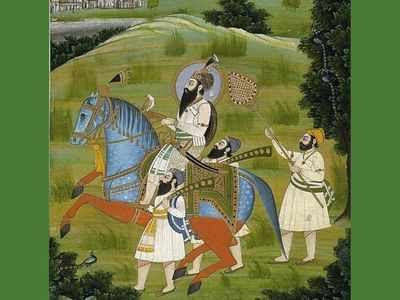
GURU GOBIND SINGH IN A PAINTING.


SRI GURU GOBIND SINGH ..(1666-1708)

This painting is very likely a real contemporary painting of Sri Guru Gobind Singh who is seated with Sidh Sen( Green Chola) ,the Raja of Mandi ( HP) .
Guru Gobind Singh  had visited Mandi during the rule of Raja Sidh Sen at the end of the 17th century. He was a guest of the Raja for a few months. The painting was commissioned by the Raja in 1701 when Guru Ji was 35 . Guru Ji's famous blue horse can also be seen at the lower right side the painting . The painting is presently with Metropolitan Museum of Art ,New York.
                                       

             ( Another painting showing Guru Gobind Singh  on his blue horse )                             

Raja Sidh sen was a worshipper of Shiva ,Durga and Chandi . The painting has been done by Khinnu , the court painter of Raja Sidh Sen. Khinnu also did many portraits of Raja Sidh Sen. I saw one such portrait in the Philadelphia Museum of Art in the US.

History informs us that Raja Sidh Sen was highly impressed by Guru Ji's personality and his relentless fight against the oppression of the rulers of that period. 
A beautiful Gurudwara has also come up in Mandi at the spot where Guru Ji had stayed.

Guru Ji was a great poet. A poet of intense feelings. As poet, he was proficient in Sanskrit, Brij Bhasha ,Persian, Hindi and Gurmukhi .

"Saach kaho sun layho sabhai
Jin praym kee-o tin hee prabh paaee-"

( I tell the truth, 
Let one and all listen it,
In this world ,
only those who loved others 
,realized almighty GOD)

( Verses of Guru Gobind Singh  )

( Avtar Mota)

Creative Commons License
CHINAR SHADE by Autarmota is licensed under a Creative Commons Attribution-Noncommercial-No Derivative Works 2.5 India License.
Based on a work at http:\\autarmota.blogspot.com\.

Tuesday, October 25, 2022

A POEM OF ASHOK VAJPAYEE I SHALL GO, WHEREVER YOU DESIRE.


    ASHOK VAJPAYEE  IAS ( born 1941)

  Ashok Vajpayee  is a well known  Hindi poet , critic, art  administrator and a civil servant. He   served as Chairman ,  Lalit Kala Akademi .He also established the Bharat Bhavan in Bhopal.He is the recipient of the Sahitya Akademi Award (1994) for his book Kahin Nahin Vahin.
About poetry , he writes this :-

 “Today, the basic struggle of poetry is to protect the personal, which the public world is all too eager to devour . . . Poetry is a civilizational critique of the public from the standpoint of the personal and the individual . . . It is not a celebration of the personal but its exploration, which renders our relation with the public simultaneously creative and critical. It is an unending satyagraha (non-violent resistance) against impersonality, totalization and simplification . . .”

  His  poems   bear stark  influence of Polish poetry ; simple, straight and heartfelt. I have translated some poems of Ashok Vajpayee. Here is a sample..

तुम जहाँ कहो
वहाँ चले जायेंगे
दूसरे मकान में
अँधेरे भविष्य में
न कहीं पहुँचने वाली ट्रेन में

अपना बसता-बोरिया उठाकर
रद्दी के बोझ सा
जीवन को पीठ पर लादकर
जहाँ कहो वहाँ चले जायेंगे
वापस इस शहर
इस चौगान, इस आँगन में नहीं आयेंगे

वहीं पक्षी बनेंगे, वृक्ष बनेंगे
फूल या शब्द बन जायेंगे
जहाँ तुम कभी खुद नहीं आना चाहोगे
वहाँ तुम कहो तो
चले जायेंगे

( Tum Jahaan Kaho )

Tum Jahaan kaho
Vahaan chale jaayeingay,
Doosre Makaan mein,
Andhere Bhavishya mein ,
Na kahin Pahunchaane vaali Train mein …

Apnaa  Bastaa  Boriyaa  Uthaakar ,
Radhi  ke  bojh saa
Jeevan ko peeth par laadh-kar 
Jahaan kaho Vaheen chale Jaayeingay ,
Vaapas iss shahar ,
Iss chogaan , Iss Aangan mein nahin Aayeingay..

Vaheen Pakshi Baneingay 
Vriksh Baneingay ,
Phool  ya  shadbh ban jaayeingay ,
Jahaan tum khud nahin aanaa chaahogay 
Vahaan tum kaho to chale Jaayeingay..

( Ashok Vajpayee)

(Wherever you tell me , 
I shall move to that place, 
 another house ,
towards a dark future ,
or board a train that goes nowhere .

Carrying my bag and baggage,
like a pack of waste material ,
carrying this life too on my back,
 wherever you desire ,
I shall move to that place ,
 and never shall I return 
to this city ,
to this Meeting point ,
and to this courtyard .

There , at that place ,
I shall become a bird,
 or a tree ,
or a flower 
or a Word .
A place , 
where you yourself
   won’t like to come  ,
If you  desire ,
I shall move to that place .)

Ashok has also been decorated by the President of the Republic of Poland with the outstanding national award 'The Officer's Cross of Merit of the Republic of Poland' (2004), and by the French government with the award of 'Officier De L'Ordre Des Arts Et Des Lettres' (2005).

( Avtar Mota )


Creative Commons License
CHINAR SHADE by Autarmota is licensed under a Creative Commons Attribution-Noncommercial-No Derivative Works 2.5 India License.
Based on a work at http:\\autarmota.blogspot.com\.

A POEM OF ASHOK VAJPAYEE..LET US SIT TALK AND RESOLVE..


IF THERE IS MUTUAL EMPATHY, SIT TALK AND RESOLVE...

I am adding a poem of Ashok Vajpayee to this photo...

(एक बार जो ढल जाएंगे
शायद ही फिर खिल पाएंगे।
फूल शब्द या प्रेम
पंख स्वप्न या याद
जीवन से जब छूट गए तो
फिर न वापस आएंगे।
अभी बचाने या सहेजने का अवसर है
अभी बैठकर साथ
गीत गाने का क्षण है।
अभी मृत्यु से दांव लगाकर
समय जीत जाने का क्षण है।
कुम्हलाने के बाद
झुलसकर ढह जाने के बाद
फिर बैठ पछताएंगे।
एक बार जो ढल जाएंगे
शायद ही फिर खिल पाएंगे।..........( Ashok Vajpayee,)


                     (Ashok Vajpayee )

My simple English rendering of the poem is as under:- 

(Once shed,
Rarely shall we bloom again.
A flower,
A word,
Love,
Wings,
Dreams,
 Or memories,
Once these move away from life 
Never ever do they return.
This is the time to save ,
 Secure them carefully ,
This moment,
 I mean ,  
This very moment,
Let us sit and sing together.
At this moment, 
Putting stakes on death ,
Let us win time .
Once it fades ,
Once it fritters away,
 we may regret later.
Once shed,
Rarely shall we bloom again..)

( Avtar Mota )

Creative Commons License
CHINAR SHADE by Autarmota is licensed under a Creative Commons Attribution-Noncommercial-No Derivative Works 2.5 India License.
Based on a work at http:\\autarmota.blogspot.com\.

Monday, October 24, 2022

RANGOLI ON DEEPAWALI..


RANGOLI ON DEEPAWALI...

In Kashmir , there had been an ancient tradition of decorating and painting walls, entrances and passages on marriages, birthday celebrations of deities and other religions and social festivities. Nilamata Purana is clear about it. Known as Grih -sobha, Dwar- sobha and Bhumi-sobha, this tradition has not died down totally. For various reasons, the tradition didn't remain as expressive as it used to be but Bhumi- sobha and Dwar -sobha survive to this day in the shape of Vyoog and Krool drawing amongst Kashmiri Pandits Though both Vyoog and Krool are now drawn during marriages only but of late , Kashmiri Pandits have revived the tradition of Bhumi-sobha on Deepawali and Shivratri.

It is considered auspicious to draw colourful and circular( representing cosmos) Vyoog or Rangoli during special occasions and religious ceremonies. Rangolis are believed to have spiritual perspective and benefits. A part of an ancient Indian Culture, Vyoog or Rangoli is used to beautify homes, places of worship and any place that calls for celebration.
Kolam in Tamil Nadu , Alpana in West Bengal, Jhoti or Chita in Odisha, Muggulu in Andhra Pradesh, Aripana  in Bihar and the colourful Rangoli in the North India are akin to  the Vyoog of Kashmir. All these decorations fall in the category of Bhumi-soba appearing in Kashmir's Nilamata-Purana.. 

MAY THIS COSMIC COMBINATION OF COLOURS AND PATTERNS BRING HAPPINESS TO ALL .

 HAPPY DEEPAWALI.

( Avtar Mota) 


Creative Commons License
CHINAR SHADE by Autarmota is licensed under a Creative Commons Attribution-Noncommercial-No Derivative Works 2.5 India License.
Based on a work at http:\\autarmota.blogspot.com\.

Saturday, October 22, 2022

ACTRESS MEENA KUMARI AND LOVE SONGS


LOVE SONGS OF MEENA KUMARI (1932 to 1972)

Baar baar tohe kyaa samjhaaye paayal ki jhankaar, tore bin saajan laage na jiyaa hamaar.

(How many times shall these tinkling anklets make you believe one simple thing? Love, without you I am restless and undone.)

Who says Meena Ji performed nothing except tragic roles? The above song from Aarti, released in 1962, written by Majrooh Sultanpuri and composed by Roshan, presents another on screen dimension of her talent: grace, happiness and the quiet satisfaction of a woman in love. It is not the Meena Kumari of tears and parting. It is the Meena Kumari of belonging. Her eyes are not lowered in sorrow. They are lifted in trust. Her walk is not heavy with fate. It is light with the knowledge that she is loved.

There is a particular softness in the way she sings this song. She does not plead. She does not accuse. She reminds. She reminds her beloved, again and again, as a woman does when she knows her love is true and only wishes it to be recognised. The anklet becomes her voice. Each small sound is a heartbeat. Each step is a confession. She is telling him that her world has found its centre, and that centre is him. In that moment, tragedy is far away. What remains is tenderness, and the gentle authority of a woman who knows her own heart.

That tenderness had a lineage. Meena Ji was born Mahjabeen Bano to Ali Bux and Iqbal Begum. Her mother, born Prabhavati Devi, came from a Bengali family connected to the Tagore family. Her grandmother Hem Sundari Tagore was a distant cousin of Rabindranath Tagore. This is not a claim that Meena Ji studied Tagore or modelled her art on his writings. It is a fact of birth. The blood of a family that gave Bengal its poetry and its music ran in her veins through her mother. Perhaps that is why there was always something literary about her, something that went beyond acting. She was not only performing a song. She was living a verse. Her own poetry, written under the pen name Naaz, carries that same inward, wounded and luminous quality.

Scientists say that with a feeling of being wanted, appreciated and loved, the levels of dopamine and phenylethylamine also go up in the body. They increase focus while creating a sense of euphoria and wellbeing. A person may feel happy, satisfied and motivated. The mind becomes clearer. The heart becomes calmer. The ordinary world begins to shine. Science, in its own language, is only describing what Meena Ji had already shown on the screen many years before. Love does not merely please us. It restores us. It gives a tired mind a reason to wake in the morning and a weary heart a reason to keep beating.

Love has an unthinkable power. It not only moves human hearts but also touches animals and birds. I have seen some animals and birds developing an emotional relationship with human beings. They often return their non materialistic and emotional feeling of love to human beings. A dog waits at the door long after its master has gone. A bird returns to the same window, to the same hand that once fed it. A cow recognises the voice that calls it by name. These creatures ask for nothing. They do not seek wealth or fame or promise. They seek only presence. And in their silent loyalty, they teach us that love, in its purest form, is not a transaction. It is a remembrance.

A love that is acknowledged and reciprocated touches some inner cords within the heart of every woman. This is the moment when the external world looks beautiful and worth living. The fire that love ignites comes like a warmth that starts melting frozen mess within and around her. For a woman who has known loneliness, who has known waiting, who has known the cold of being unseen, such a moment is not small. It is a kind of rebirth. The past does not vanish, but it loses its sting. The wounds do not disappear, but they begin to heal. She begins to look at herself not as someone abandoned, but as someone chosen. Meena Ji has presented this beautiful feeling of a woman in love through many of her songs, and she has done so with a dignity that still moves us.

I am also reminded of some more songs. Mera dil ab tera o saajana, that Shailendra wrote for Dil Apna Aur Preet Parayi, is one such song. "Kitna haseen hai mausam, kitna haseen safar hai" , is another song written by Pandit Narendra Sharma that can be added to this long list. In each of these songs, there is the same glow. The season itself seems to change because the heart has changed. The journey seems beautiful because she is no longer travelling alone.

There are some more songs like "Door koyi gaaye", "Chali gori pi se milan ko chali" , "O sajna mere ghar angnaa" , "Aate jaate pehloo mein aaya koyi" , "Meri jaan meri jaan pyaar kisi se ho hi gaya hai hum kya karein", "Ja ri ja ri o kaari badariya", and "Piya aiso jiya mein samaayi gayo re". In these songs, Meena Ji never expresses a feeling to change the man she loves. She accepts him as he is. In love, imperfections do not matter. She carries a feeling that none is perfect and as such does not talk about all those issues. This is perhaps the most painful and most beautiful part of her art. She does not demand perfection. She offers devotion. She does not try to remake her beloved. She tries only to keep him close.

No discussion of her love songs can be complete without Pakeeza, released in 1972, the film that became her swan song. In Chalte chalte yunhi koi mil gaya tha, in Inhi logon ne le liya dupatta mera, in Thare rahiyo o baanke yaar, she gave us a love that is at once graceful and wounded. The music of Ghulam Mohammed wrapped her in a soft, almost prayerful melancholy. Here love is not youthful play. It is a mature, waiting love. A woman who has been hurt by the world still believes in the tenderness of one man. When she sings Chalte chalte, it is as if she is walking through her own life, remembering every parting, every unfulfilled promise, and yet still hoping. Pakeeza did not merely complete her career. It revealed her soul.

Who can match Meena Ji's style in presenting the intense feeling of a woman in love? In her love songs, she walks, runs and dances with a happiness that appears reassuring and deep within her heart. In the songs quoted by me, she is possibly moved by the sweeping feeling of being owned, acknowledged and loved. To be owned here does not mean to be possessed. It means to belong. To know that somewhere there is a heart that answers to yours. To know that your absence would be felt. To know that your presence matters.

And yet, behind this happiness, there is a quiet pathos that only Meena Ji could carry. We, who watch her now, know what life did to her. We know the loneliness that followed her fame. We know the silence that lived inside her crowded rooms. So when we see her smile in these songs, our hearts ache a little more. We wish that the happiness she performed had stayed with her in real life. We wish that someone had held her hand with the same tenderness with which she held out her own. We wish that the love she gave so generously had returned to her in equal measure, and stayed.

That generosity was not confined to the screen. Those who knew her remember how liberally she spent, not on herself, but on others. She gave away money, jewellery, clothes and food with an open hand. Technicians, junior artists, servants, struggling poets, anyone who came to her door in need, rarely returned empty handed. She paid the medical bills of people she barely knew. She helped families marry their daughters. She did not keep accounts of her kindness. Money, for her, was never a treasure to be hoarded. It was a means to ease another person's pain. It is a cruel irony that a woman who gave so much died in financial distress, but that is the truth of her life. She was rich in heart and poor in the ways of the world.

That is why these songs are not merely songs. They are a record of a longing. They are the voice of a woman who understood love not as a pleasure, but as a prayer. She sang of union as if she knew separation. She sang of joy as if she knew sorrow. And in that knowledge, she became immortal. Long after the lights have faded, her anklets still sound in our memory, reminding us that to love and to be loved is the deepest hunger of the human heart, and the most beautiful ache that a woman can ever carry.

(Avtar Mota)


Creative Commons License
CHINAR SHADE by Autarmota is licensed under a Creative Commons Attribution-Noncommercial-No Derivative Works 2.5 India License.
Based on a work at http:\\autarmota.blogspot.com\.

Friday, October 7, 2022

APPLES FROM KINNAUR (HP)

APPLES FROM KINNAUR ( HP) Kashmir apple is going to face some tough competition within the country . Now a new variety of apple from Kinnaur , Himachal that is sweet , juicy and has better shelf life has started capturing the market in many cities like Chandigarh, Delhi, Mumbai, Ahmedabad and Lucknow. In Panchkula ,I bought and tasted this apple recently. I am not referring to the traditional Kulu or Manali variety . I say about the red variety of Kinnaur apple with thick skin that is gradually becoming the most sought after variety in some cities now. At 120 rupees per kg, this apple is giving a tough competition to the imported varieties as well . A fruit vendor in sector 20, Panchkula told me this:- " I had been selling Californian or Chinese apples to the residents of this housing colony . Since last year, I only sell Kinnaur and Kashmiri delicious apples. But the demand for Kinnaur is expanding day after day . I have repeat customers. It looks like a variety of imported Californian apple . It is sweet and then free from wax coating and very cheap. I have sold about 45 boxes this September month upto 17th . Early delicious from Kashmir is good but it turns dry and juiceless later . I was told in fruit Mandi that one more variety of Kinnauri apple shall be rolled in markets by Himachal government next year. " In Panchkula, a doctor from Himachal Pradesh told me this:- "Apples from Kinnaur are known for their natural sweetness, color, succulence, and prolonged shelf life. These are grown at an altitude of over 9,000 feet. You must taste some popular varieties of Kinnaur apples like Royal, Golden, Red Golden, Red Delicious, and Scarlet Spur." Let us know that about 7500 varieties of apples are grown throughout the world and 100 varieties of apples are grown commercially in the United States of America alone . ( Avtar Mota) Creative Commons License
CHINAR SHADE by Autarmota is licensed under a Creative Commons Attribution-Noncommercial-No Derivative Works 2.5 India License.
Based on a work at http:\\autarmota.blogspot.com\.
Thursday, October 6, 2022

THE NATIVE AMERICANS

PAINTINGS SHOWING PEOPLE FROM NATIVE AMERICAN TRIBES .


 In Manhattan, Rabiyo is my African American friend..He is simple, helpful and a well informed person. Rabiyo knows much about America and its history. He reads New York Times and Time magazine.I feel a need to speak to him quite often. And he feels enthused to speak and communicate . 

One day while discussing the native Americans , he told me this:- " The Hollywood show native American in poor light. You get me. Tough ,riding horses, cowboys, hunters and aggressive . All bluffing and not truth. It all false. That very old culture. Old beliefs. Old food habit system. Old symbol arrow, butterfly, bear and many .That old dress, jewelery and language. Now they go modern education and all adopt Immigrant culture that anybody call new American culture style . More than 70% native living cities now. Young native American living city not take reservations benefit. They go competition in all work and all field now. Now no land , no hunting no fishing . Only I say about 20 % native peoples live tribe lands but use modern culture and living style. Rest city living style all. Now all American. you get me.Here native sharp, intelligent.They give land to peoples coming from Europe and become poor and Christian. Many die with diseases that Europe Immigrants bring . They no immunity. You get me. I tell many peoples name. They all native .. They here 15000 years. Some go Apache tribe. Some Chhipewa tribe.Some Shoshone tribe. These tribe names. You note sir . Dave Anderson CEO famous Dave's Barbecue franchise . He Chhipewa tribe. He more than 180 big restaurant in the US .Why you not note ?" "

 I am noting everything.. No worry."

 "You no diary pen. You note on mobile ! Okay Okay. Note second .Henry Red Cloud .He own Lakota Solar Enterprise in the US. All popular solar appliances he make. He direct descendent famous Red Indian Chief Sioux or Sioux Chief Red Cloud. He and his tribe fight the US army for control of their territory in Montana. The American Indian wars. Native fight new immigrant .You get me.Hey sir, Note third. T D Petiite. He known as T David Petite .Inventor and entrepreneur. He manufacturing health care instruments and smart meters. He get award by US president. Note fourth. Note Will Samson. He very good Hollywood actor.. So many films he go act. 'One flew over cuckoo's Nest 'he Milos Forman film. So many native peoples in Hollywood acting, dance music .so many .You get me.You noting ! I forget . I not remember then. " 

 "Yes continue. I am noting all."

 "O sir sometime mobile go delete all that you record what you noting . What you then doin Sir? Note.. Merritt Johnson. She Mohawk and Blackfoot mix tribe . She well known painter. I say great . What you doing mobile WhatsApp? Not right time. All you note get delete. Sir one job one time. That correct." 

 " Please continue. I am noting all.Dont worry."

 "Then note. Preston Singletary famous glass artist native tribe. You seeing glass Museum when you visit Niagara fall. That artist.I tell you 15 big names if you proper pen and paper. How you noting so much on mobile? Sorry I having no paper or pen here. What I do? " 

 " Please continue. I again say i am noting all. Rest assured." 

 "So they all sharp ,intelligent and enterprise not what you see in cinema .They foot on ground. I introduce you tomorrow native gentleman big big Chief in company but humble. He like Indian peoples. One Sikh gentleman his friend. When Sikh gentleman see me market store , he say Rabiyo come my apartment , I cook chicken Indian spice. " 

 "So the Sikh gentleman is also your friend." 

 " Yes, he my friend like you.Sir you asking questions anybody you meeting. What you doing so much information? . I like how you go efforts learning new new things honest and sincere. That good. Sir good peoples not many sincere friends . Few few but right peoples only .No fake.. If you stay here, you easily fix job. You go teaching. Any school waalcom . " 

 (Avtar Mota)


 Creative Commons License
CHINAR SHADE by Autarmota is licensed under a Creative Commons Attribution-Noncommercial-No Derivative Works 2.5 India License.
Based on a work at http:\\autarmota.blogspot.com\.

Monday, October 3, 2022

GODDESS LAKSHMI FROM KASHMIR IN BRITISH MUSEUM ,LONDON.


GODDESS LAKSHMI FROM KASHMIR IN BRITISH MUSEUM ,LONDON.

This stone (grey chlorite ) sculpture possibly done in 7th century is on display in British Museum . The goddess is shown in (1) Pralambapadasana pose seated on a lion throne . The goddess is crowned with a diadem made up of three crescent moons. Done during the rule of Karkota Kings , the sculpture bears Mathura and Gandhara influence. The deity has two male attendants . In Kashmir, a large number of deity sculptures either done in stone or metal depict attendants who look towards the deity . The sculpture was acquired in 2016 by the museum. 

The Karkota rulers were worshippers of Shiva, Vishnu and Buddha. In fact one of the reasons for decline of Buddhism in India could be attributed to the fact that Hindus treated Buddha as a deity by worshipping him as a Swaroopa of Vishnu .In Indian Vaishnava tradition also , Gautama Buddha, is considered as the ninth Avatar among the ten major Avatars of the Vishnu. The Karkota rulers of Kashmir also gave similar deity status to Buddha .

 The Karkota Kings also worshipped every deity's Parivaara. Accordingly one finds many sculptures done during Karkota rule that show Shiva Parivara and Vishnu with Lakshmi. 

Images of Lakshmi started appearing around the third century BC in sculptures found in Kausambi, in north India, and on coins issued during the reign of the Gupta dynasty around the fourth century AD. She became a favourite of kings as more and more people believed she was the bestower of power, wealth and sovereignty.

In the Buddhist Jatakas, there are tales of men and women who request the goddess Lakshmi to drive away the goddess of misfortune, Kalakanni. Images of Kubera, the pot-bellied yaksha-king and treasurer of the gods, who is closely associated with Lakshmi, adorn many Buddhist shrines.

Like the Greeks had Persephone, the corn-goddess, who was known to Romans as Demeter. The Egyptians had Isis, Sumerians had Inanna, Babylonians had Ishtar, Persians had Anahita and Vikings (ancient warrior tribe who were natives of Scandinavia from basically three countries- Denmark, Norway and Sweden) had Freyja, Lakshmi is the Hindu form of the timeless and universal mother-goddess who nurtures and nourishes all life. 

( Avtar Mota )

PS
(1)

Pralambapadasana... (Prasanna) is a posture mentioned in Hindu scriptures. In Shilpshastra , it is mentioned that the deity should look seated on a chair, both legs hanging down and the feet resting on the ground. This position should indicate that the deity is deep in contemplation.


Creative Commons License
CHINAR SHADE by Autarmota is licensed under a Creative Commons Attribution-Noncommercial-No Derivative Works 2.5 India License.
Based on a work at http:\\autarmota.blogspot.com\.