THE
REVIEW OF THE BIOPIC ON BHAGWAN GOPI NATH (1898-1968) RELEASED ON 8TH MARCH,
2025 AT JAMMU
“Na takht o taaj
mein na lashkar I sipaah mein hai
Jo baat mard e
qalandhar ki baargaah mein hai....”
(A monarch’s pomp
and mighty arms can never give such glee,
As can be felt in
the presence of a Qalandar bold and free.)
Bhagwan Gopi Nath was a mystic,
Siddha, saint and spiritualist of the 20th century Kashmir. He remains the most
revered saint among Kashmiri Pandits with his Ashrams at Srinagar, Jammu, New
Delhi, Bengaluru, Ghaziabad, Kanga, Pune and some more locations in the
country. Bhagwan Gopinath lived a very confined life and avoided glare and
publicity. Hardly did he ever move out from the Kashmir valley. He was known as
Aghoreshwar, and he mostly preferred to remain silent. For those who came to
see him, he was an ocean of compassion and care. Never did he look at their
caste, creed, colour or beliefs.
Bhagwan Gopinath belonged to the Bhan
family from Bhana Mohalla in Srinagar city. His father Pandit Narayan Joo Bhan
was a Pashmina trader. From childhood, Bhagwan Gopinath exhibited detachment
from the world and habitually visited the abode of goddess Sharika at Hari
Parbat. After completing his education at the ‘Christian Missionary Society’
school of Fateh Kadal in Srinagar city, he joined Vishinath Press as a
compositor. After some time, he opened a shop in downtown and later in
Sekidafar. Finally he renounced the worldly activities and focused on Ishwar
Sadhana. He lived in some houses but at every place, he kept a dhoni (sacred
fire) burning before him and offered oblations into it. He also engaged himself
in the unending process of Naam-Japa using every breath without murmuring a
word for others to listen. He performed penance at many sacred places in
Kashmir include Khrew ( Jwala Ji ), Hari Parbat ( Sharika Devi ) , Kheer
Bhawani ( Ragnya Devi ) , Ishber , Pushkar Raj Bhairav , Bhadrakali Temple near
Handwara , Zyeshta Devi , Martand Temple , Pokhribal Temple , Gautamnag ,
Vichaarnag etc. Some select devotees always accompanied him on these
pilgrimages.

( The Team )
Through his miracles and blessings, he
remained a great benefactor of Kashmiris in general. In 1947, he is believed to
have assured his apprehensive disciples to convey to people in general that the
tribal raiders would never enter Srinagar city. As his name and fame spread,
many spiritual Gurus from the country would visit him but he always avoided
publicity and glare. He remained confined to his own Sadhana and Naam-Japa
before the ever-burning Dhooni. Amongst his devotees, one can include Justice
Shiv Nath Katju of Allahabad High Court. Modern Hindi poet Sumitranandan Pant
also wrote a poem on Bhagwan Gopinath. Bhagwan Gopinath Knew Hindi, Urdu,
Persian and Sanskrit. He could also read and write Sharada script. He was a
connoisseur of classical music and many Bhajan Mandalis performed before him.
Pandit Ved Lal Dhar and Sufiana singer Mohammad Abdullah Tibetbaqaal would also
perform before him.
( The musicians who performed before Bhagwan Gopinath Ji )
The present biopic titled”
Sarvavyapak: Bhagwan Gopinathji” is based on the biography of Bhagwan Gopinath
written by S N Fotedar. The script and screenplay (in English) for the film
have been written by Padamshri Pran Kishore Kaul. There could have been no
better person to write the script and story than Pran Kishore Kaul who apart
from being the pioneer of radio drama, has also successfully scripted some very
popular serials for television, including Gul Gulshan Gulfam. ‘Maenzraat’, the
first Kashmiri feature
film directed by Pran Kishore Kaul, received ‘Silver Peacock’. The stage adaptation of poet Dina Nath Nadim’s
opera ‘Bombur ta Yemberzal ‘was superbly directed by him and shown to the
Russian delegation in December 1955 in Srinagar. The Russian delegation
included Marshal Bulganin and Nikita Khrushchev. He also
directed the stage adaptation of ‘Vitasta’ opera scripted by
Dina Nath Nadim. The opera was performed in various cities of the country and
it won rave reviews in print media everywhere. Pran Kishore Kaul, known as the
master of his craft, especially theatre, drama and films has pooled his
creative energy even at this advanced age to make this biopic something that is
going to enthuse, appeal and captivate the audience. About the film, Pran Kishore
Kaul said this:-
“When
Sanjay Kaul ( producer ) and Jaya Patwari ( trustee of Bhagwan Gopinath
Ashram ) entrusted the task of making this biopic to me , there
were many difficulties . Hardly anything detailed had been written about
Bhagwan Ji’s life and work. His first line of devotees were no longer living.
People only spoke about some miracles with no authenticity or source.
Fortunately, I saw S N Fotedar’s book on Bhagwan Ji and heaved a sigh of
relief. I read many books, interviewed many people and grasped his life story
and work and then set to write the script and finally the screenplay. I have
always believed in the team that I built over the years. They came at the first
call almost free. We spotted our actors from gatherings and acquaintances. Most
of them are first-time actors. They are engineers and technocrats. Bhagwan
Ji’s role was played by a young boy from Jagti, Jammu who was recommended by
Makhan Lal Saraf. Waheed Jeelani, Raja Bilal, Kishen Ji Langoo, Vir Ji Sumbly,
Dilip Langoo, Abhay Rustom Sopori, K K Raina, Vijay Mattoo, Saurabh Zadoo,
Sanjay Nahar and many came without a fee. We have done something impossible in
a meagre budget.”
Pran Kishore Kaul has used four
popular Leelas or devotional songs of Mahatma Krishen Joo Razdan in his biopic
"Sarvavyapak: Bhagwan Gopi Nath Ji ". These are:-
(1)
"gatta tsajji gash aav chaane zennai
Jai jai jai devki
Nandanai"
( Darkness has withered away and light has spread all
around upon your birth.
Victory, victory and victory to you, O son of Devki )
(2)
" hosh dim lagayo pamposh paadan
ha saadan
haendh saadho lo "
( Grant me awareness, my life at your lotus feet
O highest one among all the saints ). This
composition of Mahatma Krishen Joo Razdan is based on Rishi Vasugupta's Shiv
Sutra, "Awareness is the knowledge".
( 3)
"beil ta
maadal venna gulaab pamposh dastai
poozai laagas
param shivas shiv nathastai.."
(For your pooja archana,
I bring bundles of beil patra,
maadal flowers, herbs,
roses and lotus flowers,
O Param Shiva
O Shiv Natha .)
(4)
" Aadhaar
zagtuk kunuyi chhu mantar
Shivai namoh om
namoh shivai "
( This universe is founded only on one Mantra,
' Shivaye Namoh Om Namoh Shivaye " )
In this biopic, apart from the above
devotional songs, Pran Kishore Kaul has also picturised a great scene in which
women are shown singing Adi Sankara's famous Devi stuti, " gauri amba
ambur hakshe aham -eide" while Bhagwan Gopinath Ji is performing a
Homa. The Shiv Leela of poet Radhe Nath Masarat," chaane
darshan kuyi chhum haavas shankar naavas pooza chheyi " has also been
picturised with Bhagwan Ji performing Homa using the ever-burning Dhoni (
sacred fire ) before him. And Bhagwan Ji is shown giving whatever money he has
with him to the Sadhus proceeding on the Amarnath Yatra. In this biopic, one also hears
Henze Vanvun, a group singing practised by Kashmiri Pandits in marriages
and Yageopavit( sacred thread ) ceremonies and linked to Sama Vedic
chants. We are shown Pandit Ved Lal Dhar Vakil, Jagan Nath Shivpuri, Mohammad
Abdullah Tibetbaqal, singing in the Darbaar of Bhagwan Gopinath who
himself was a connoisseur of Hindustani classical and Kashmiri Sufiana music
rendered with soothing beats of Santoor. Kudos to Pran Kishore Kaul for
bringing Santoor maestro Abhay Rustom Sopori for the background music.
Pran Kishore Kaul has also brought in Kishen Ji Langoo, his old associate
at Pragaash Productions ( a production company of Pran Kishore Kaul
) to score music of Leelas and devotional songs for the film. The orchestration
by Saurabh Zadoo, Raja Bilal, Waheed Jheelani and Dilip Langoo was at Pran
Kishore Kaul’s specific request. Dilip Langoo has also contributed as an actor.
The cinematography by Avinash Satoskar is equally superb. Arun Mavanoor as
co-director of the project has also brought some of the latest techniques into the
project. Vir Ji Sumbli as art director and actor needs appreciation.

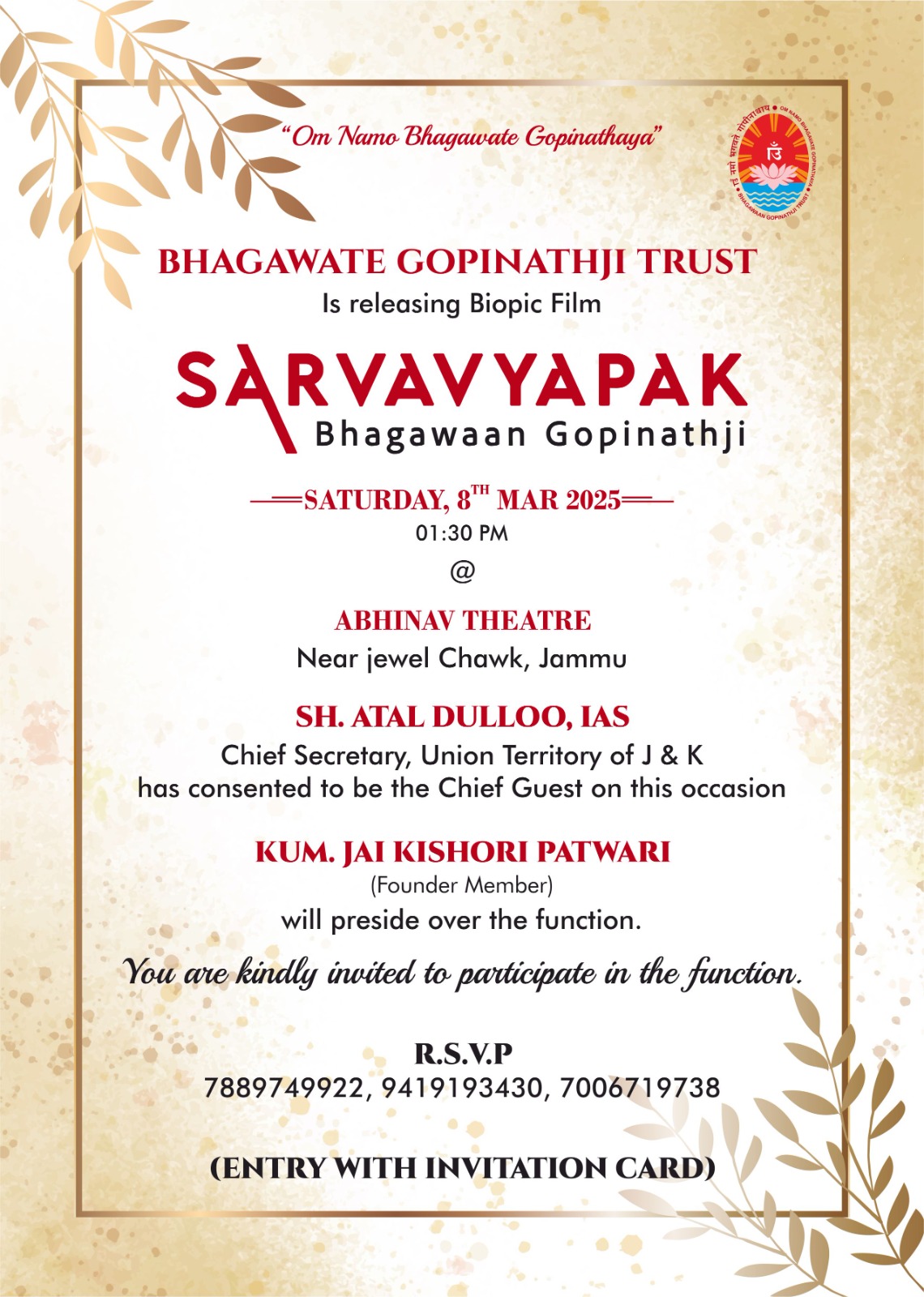
The film was premiered and released on
8th March 2025 by Bhagwan Gopinath Trust at the Abhinav Theatre Jammu
with Shri Atal Dulloo IAS, Chief Secretary J&K UT being the Chief
Guest of the event. It is currently being shown in some cinema halls in Jammu.
Tickets are available at Bhagwan Gopinath Trust, Udhaywala, Jammu. Watch this
labour of love on a bigger screen to have some unforgettable cinemascope feel
and satisfaction. We are informed that Kashmiri version of the biopic is also ready. Many many more creative years to Pran Kishore Kaul. He has
done something impossible at his age.
(
Avtar Mota )