
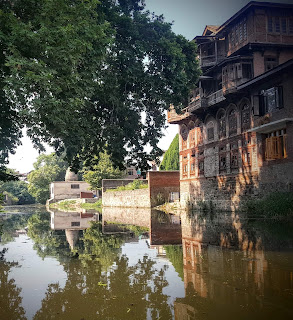
( House of Dr Ghulam Nabi Hakim close to Naidyar bridge.)
(NAIDYAAR AREA OF RAINAWARI IN SRINAGAR CITY ..)
On one side of the Naidyar canal, we had tall and shady Chinar trees of the D.A.V. School, Rainawari. There was an old bridge over the canal near the D.A.V. School. This canal connects Dal lake with Nigeen lake. When we were students of the D.A.V. School, we would see frequent water transport on this canal. Tourists in Shikaras going to Nigeen from Dal lake or vice versa and children bathing in canal waters smiling and crying at foreign tourists ‘ Meemi Salaam Pataa Pataa Ghulam’. V S Naipaul passed through this area in a Shikara. This area is mentioned in his Book ‘ An Area Of Darkness ’
What is the origin of word Naidyaar?
Dr Shashi Shekhar Toshkhani ( scholar, linguist and poet ) clarifies:- "
" Naavid’ or Naaid, there are several words in contemporary Kashmiri speech that exist in more than one form. One such word is ‘Naavid’. It is derived from Sanskrit "Naapita", meaning ‘barber’, (medial 'p changing to 'v', as happens typically in Prakrit). It also occurs in the form of ‘Naayid’. The two forms denote two different stages of development from the Sanskrit original. It may be noted that ‘Naayid’, which represents the later stage, is quite akin to Hindi ‘Naai ’, which is also derived from Sanskrit ‘Naapita’. This makes Kashmiri an important subject for study in the Indian linguistic context, as pointed out by George Buhler who has also chosen to give ‘Naavid’ and ‘Naaid’ as one of the examples to illustrate his point.’
So the name has been derived from word Naavid meaning barber in Kashmiri.
You would always see vegetable sellers in boats, boats with school-going children, boats with weeds brought from Dal lake and boats with sick brought from Dal area to doctors in Rainawari. This was a common scene of traffic on Naidyar canal. During the daytime, the canal was busy and full of life. It had so many temples and mosques and Ziarats on either side of its banks. So many Ghats that were used by people for bathing, Wuzu and Sandhya before these turned filthy and contaminated. Rations sold to the public under PDS was stored in big boats ( locally known as Bahetch ) parked along the banks of the canal. Sometimes, you could see some film unit from Mumbai shooting a movie in Rainawari backwaters. However, such incidents turned rare after the seventies of the last century as shooting locations were shifted to Mughal gardens, Dal lake, Gulmarg, Aaroo, Sonamarg, Pahalgam and Nigeen lake etc.
On one side of the Naidyar canal, we had tall and shady Chinar trees of the D.A.V. School, Rainawari. There was an old bridge over the canal near the D.A.V. School. This canal connects Dal lake with Nigeen lake. When we were students of the D.A.V. School, we would see frequent water transport on this canal. Tourists in Shikaras going to Nigeen from Dal lake or vice versa and children bathing in canal waters smiling and crying at foreign tourists ‘ Meemi Salaam Pataa Pataa Ghulam’. V S Naipaul passed through this area in a Shikara. This area is mentioned in his Book ‘ An Area Of Darkness ’
What is the origin of word Naidyaar?
Dr Shashi Shekhar Toshkhani ( scholar, linguist and poet ) clarifies:- "
" Naavid’ or Naaid, there are several words in contemporary Kashmiri speech that exist in more than one form. One such word is ‘Naavid’. It is derived from Sanskrit "Naapita", meaning ‘barber’, (medial 'p changing to 'v', as happens typically in Prakrit). It also occurs in the form of ‘Naayid’. The two forms denote two different stages of development from the Sanskrit original. It may be noted that ‘Naayid’, which represents the later stage, is quite akin to Hindi ‘Naai ’, which is also derived from Sanskrit ‘Naapita’. This makes Kashmiri an important subject for study in the Indian linguistic context, as pointed out by George Buhler who has also chosen to give ‘Naavid’ and ‘Naaid’ as one of the examples to illustrate his point.’
So the name has been derived from word Naavid meaning barber in Kashmiri.
You would always see vegetable sellers in boats, boats with school-going children, boats with weeds brought from Dal lake and boats with sick brought from Dal area to doctors in Rainawari. This was a common scene of traffic on Naidyar canal. During the daytime, the canal was busy and full of life. It had so many temples and mosques and Ziarats on either side of its banks. So many Ghats that were used by people for bathing, Wuzu and Sandhya before these turned filthy and contaminated. Rations sold to the public under PDS was stored in big boats ( locally known as Bahetch ) parked along the banks of the canal. Sometimes, you could see some film unit from Mumbai shooting a movie in Rainawari backwaters. However, such incidents turned rare after the seventies of the last century as shooting locations were shifted to Mughal gardens, Dal lake, Gulmarg, Aaroo, Sonamarg, Pahalgam and Nigeen lake etc.


And sometimes you would see a dead body being carried in a boat to cremation ground located inside backwaters. Sometimes you would see a doctor sitting in the middle of a roofless boat being carried to see some serious patient by his relatives. Sometimes you would see a boat being used to collect bedding and utensils for some marriage function. Quite often a Doonga would pass by with a group of young men on a picnic. You would also hear Chhakri and Kashmiri Sufiana music being loudly played inside by some folk singers or artists.
So many handicrafts traders had set up their shops or business establishments along the canal banks. I remember some reliable exporters with names such as Ghulam Hassan And Sons, Arcson Arts, AR Chaku And Sons, Mir Handicrafts and G N Chaku And Sons etc. Ajaz, my class fellow in the D.A.V. School was from the family of Ghulam Hassan And Sons ( walnut wood carvers ).
For the handicraft shops located in the backwaters of Dal lake or Rainawari, business and buyers were brought through a well-established commission system. Apart from taxi drivers, beneficiaries of this commission were the houseboat owners, tourist guides and Shikara-owners.
There used to be stories and complaints as well; Ring Shawl cloth or semi Pashmina sold as pure Pashmina, staple thread carpets sold as pure silk carpets, Moradabadi wood carving sold as Kashmir walnut wood carving, painted wood sold as papier mache and fake saffron prepared in Nawapora locality sold as pure Mogra saffron to tourists. This was generally done by roaming boat or Shikara vendors who sold handicrafts to tourists.
Now and then some houseboat would move on this canal. The bigger houseboats were unable to pass under the not so high Naidyar bridge. There was a risk of houseboat getting damaged. Accordingly, the houseboat owner would come to our school and request school authorities for help. The boys from some free class would be made to walk into the houseboat so that it sank a little in canal waters. That made it to pass under the Naidyar bridge. This was the time when boys would slip into houseboat's kitchen area and look for biscuits, jam, bread and fruits while the owner and his family were busy in pulling the houseboat from below the bridge.
I remember Telis, Chowdhris (Dr R.L. Chowdry), Kitroos, Dr Ghulam Nabi Hakim, and Kauls lived across the canal opposite the D.A.V. School. The Hindus and the Muslims jointly celebrated annual Urs of Saint Miyan Shah Sahib. His Ziarat was close by. There used to be a small Shiva Temple close to Naidyar bridge that had a south Indian Sadhu as the caretaker.
On the other side of the canal, close to the D.A.V. School, you had Mallas, Handoos (Dr Ramjoo Handoo), Shairs( Mohd Abdullah Shair), Dalkaws, Wanis and the house of Sardar Thakur Singh. Pandit Saligram Kaul, known for his honesty and integrity, lived close by. This Gandhian Pandit fined his own family for misuse of drinking water when he saw his wife watering the family kitchen garden with a pipe that brought water from their P.H.E. connection.

( A View of Nigeen lake .. Photo Avtar Mota )
 ( A View of Dal lake .. Photo Avtar Mota )


( OLD PHOTOGRAPH OF NAIDYAR BRIDGE 1940 )
 ( PHOTOGRAPH OF NAIDYAR BRIDGE )
 ( LATEST PHOTOGRAPH OF NAIDYAR BRIDGE )

( BACKWATERS OF DAL LAKE NEAR RAINAWARI )


( BACKWATERS OF DAL LAKE NEAR RAINAWARI )

( Temple Ghat near Naidyar bridge )

( Karapora Ghaat ,Naidyaar , Rainawari ..Photo:Raman Raina)


( Karapora Ghaat ,Naidyaar , Rainawari ..Photo:Raman Raina)

(Approaching Naidyaar . Photo..Raman Raina)


We used to row a boat right up to Nehru Park from Chowdhary Bagh
Naidyar. Swim in the Dal lake, carry our food along, enjoy fresh air,
steal some ripe tomatoes and cucumbers grown in the backwaters. Quite
often, a surprise discovery of duck eggs on some small landmass in the
lake waters was a bonus.
Sometimes we would walk on foot to Nishat garden from Naidyar via the Dal lake’s inner embankment that connected Rainawari with Nishat garden. Sometimes a bicycle was used to go to Nishat from Rainawari from this path.
I did my Higher Secondary( IIIrd year ) final from the D. A. V. School, Rainawari before going to SP College. Never have I seen a teacher like Shri Dina Nath Hanjura in my
Sometimes we would walk on foot to Nishat garden from Naidyar via the Dal lake’s inner embankment that connected Rainawari with Nishat garden. Sometimes a bicycle was used to go to Nishat from Rainawari from this path.
I did my Higher Secondary( IIIrd year ) final from the D. A. V. School, Rainawari before going to SP College. Never have I seen a teacher like Shri Dina Nath Hanjura in my
. Gandhian, unbiased, compassionate and disciplinarian. He could
teach you mathematics, history, geography, political science,
philosophy, literature, drama and above all English grammar. When we
left school, he was the principal. Later, he moved to England to live
with his son.
Sh. Hanjura would also introduce Ghalib, Kabir, Wordsworth and Mehjoor to his students..
I vividly remember school Chowkidar Shri Mohd Sidiq and his son Lateef who played football with us and would always cry ‘ Running ’ while playing with the ball. There used to another gentle soul in the school who was fondly named as Moma by us. He was Ghulam Mohammed our school peon
I conclude this write up with my favourite lines of poet Munir Niazi:-
Ye ajnabi si manzilein aur raftagaan ki yaad
Tanhaaiyon ka zahar hai aur hum hain doston
Aankhon mein urr rahi hai lutti mehfilon ki dhool
Ibrat sarai-deher hai, aur hum hain doston
Phirte hain misal-e-muaj hawa shehar shehar mein,
Aawaargi ki lehar hai aur hum hain doston..
My English rendering would be …….
The present unfamiliar destinations and the memory of misplaced friends,
The poison of loneliness is what we live with now, dear friends……
These eyes carry the hurting dust of that robbery,
The robbed circle of friends!
This ruined Serai of existence has only repentance now, dear friends.
In city after city, we move like the whiff of air,
vagrant and wanderer has turned our existence now, dear Friends ...
(Avtar Mota)
Sh. Hanjura would also introduce Ghalib, Kabir, Wordsworth and Mehjoor to his students..
I vividly remember school Chowkidar Shri Mohd Sidiq and his son Lateef who played football with us and would always cry ‘ Running ’ while playing with the ball. There used to another gentle soul in the school who was fondly named as Moma by us. He was Ghulam Mohammed our school peon
I conclude this write up with my favourite lines of poet Munir Niazi:-
Ye ajnabi si manzilein aur raftagaan ki yaad
Tanhaaiyon ka zahar hai aur hum hain doston
Aankhon mein urr rahi hai lutti mehfilon ki dhool
Ibrat sarai-deher hai, aur hum hain doston
Phirte hain misal-e-muaj hawa shehar shehar mein,
Aawaargi ki lehar hai aur hum hain doston..
My English rendering would be …….
The present unfamiliar destinations and the memory of misplaced friends,
The poison of loneliness is what we live with now, dear friends……
These eyes carry the hurting dust of that robbery,
The robbed circle of friends!
This ruined Serai of existence has only repentance now, dear friends.
In city after city, we move like the whiff of air,
vagrant and wanderer has turned our existence now, dear Friends ...
(Avtar Mota)
CHINAR SHADE by Autarmota is licensed under a Creative Commons Attribution-Noncommercial-No Derivative Works 2.5 India License.
 Based on a work at http:\\autarmota.blogspot.com\.


