Tuesday, June 6, 2023

SAINTE CHAPELLE : THE JEWEL BOX OF GOTHIC PARIS


                                                   ( Avtar Mota inside Sainte  Chapelle 2026)


                 ( Avtar Mota inside the Chapelle )


Sainte-Chapelle: The Jewel Box of Gothic Paris


Tucked inside the Palais de la Cité on ÃŽle de la Cité, Sainte-Chapelle looks modest from the outside. Step in, and you understand why it’s called a “reliquary turned inside out.” Built in the 1240s, it was designed not as a Parish Church but as a Royal Chapel; a private stage set for the most sacred relics in Christendom. For seven centuries, it has done one thing better than any building in Europe: turn sunlight into story.

Why It Was Built: A King, a Crown, and Power

The man behind it was King Louis IX, later Saint Louis. In 1239, he bought what was believed to be the Crown of Thorns from the bankrupt Latin Emperor of Constantinople, Baldwin II. Cost: 135,000 livres, more than half the annual budget of France. Two years later, he added fragments of the True Cross and other Passion relics. These weren’t just holy objects. In the 13th century, owning relics meant divine legitimacy. Louis wasn’t building a church; he was building a giant jewelled case to prove France was the New Jerusalem. The chapel was consecrated on 26 April 1248, just before Louis left on the Seventh Crusade.

Architecture: The Radical Idea of Walls of Glass

 Sainte-Chapelle is Rayonnant Gothic, the “radiant” phase of Gothic that pushed structure to its limits to maximise windows.

Lower Chapel:

Dark, low, painted with fleur-de-lis on a deep blue vault. This was for palace staff and servants. The ceiling is only 6.6m high. It feels like a crypt, preparing you for what’s above.

Upper Chapel:

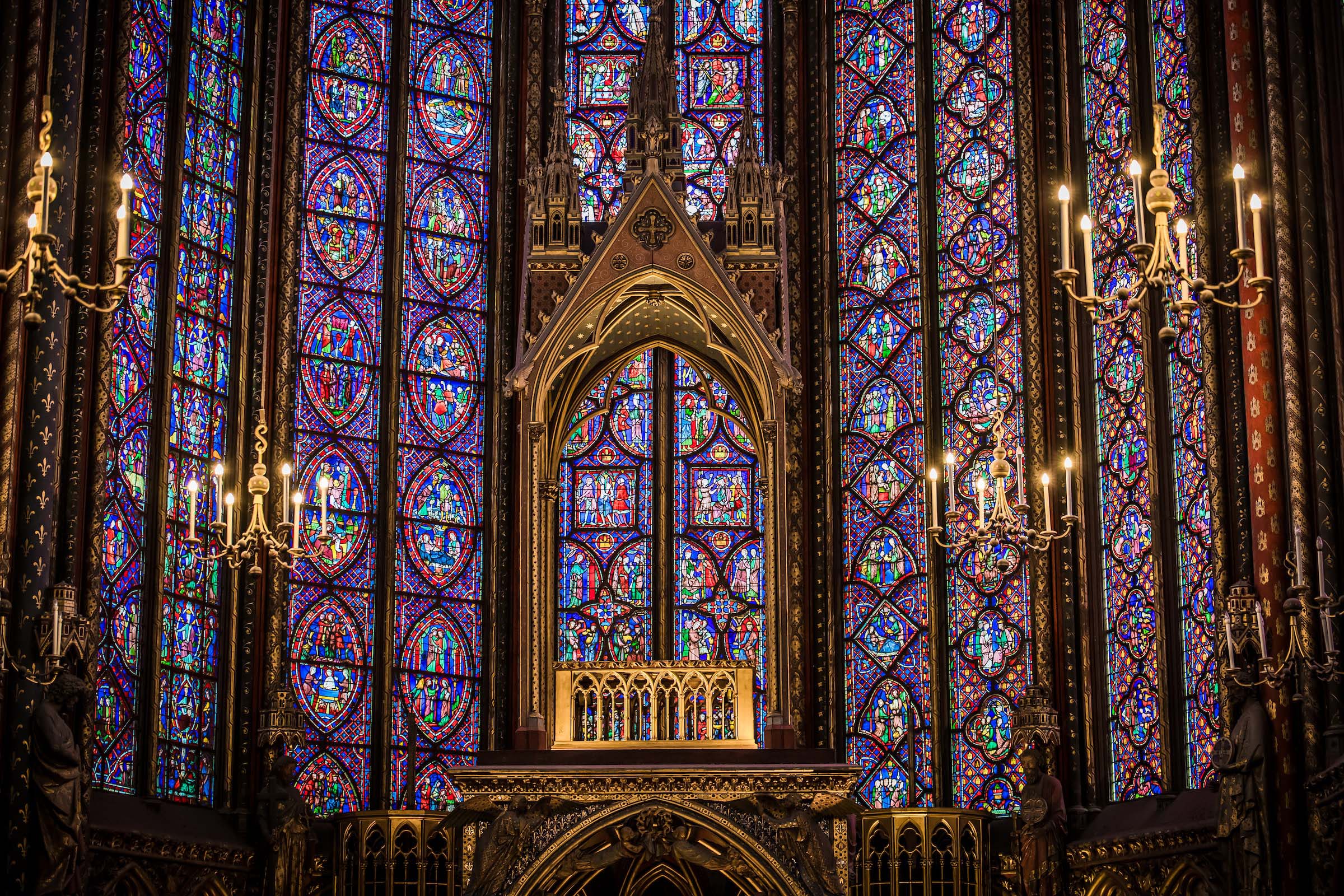
Climb the narrow spiral stair, and the space explodes. 15 windows, each 15m tall. The walls have basically disappeared. Only slender stone mullions and iron tie-rods hold up the vault 20.5m above. Of the 670 m² of wall surface, 618 m² is stained glass. That’s 92% glass. The architect is not documented, but Pierre de Montreuil, who worked on Notre-Dame and Saint-Denis, is the likely master. He pulled off an engineering stunt: the buttresses are tucked into the exterior bays, so inside you just see colour floating.

The Stained Glass: A Bible You Can Walk Through

 There are 1,113 scenes across 15 windows, read left to right, bottom to top, like a comic book in light.  It starts at the north wall with Genesis, moves through Exodus, Numbers, Joshua, Judges, Isaiah, then the story of the relics themselves. The east apse shows the Passion. The south wall covers John the Evangelist, the infancy of Christ, and finally the Book of Kings, with Louis IX himself shown carrying relics into Paris. The glass is “pot-metal”,, colour mixed into molten glass, not painted on. That’s why the reds and blues are so deep they feel physical. During WWII, the panels were removed and hidden. 720 of the 1,113 are still original 13th-century glass, the largest surviving collection in the world. The Rose Windows were added in the 15th century under Charles VIII, it shows the Apocalypse. At 9m in diameter, it faces west and catches evening sun, flooding the chapel in violet and gold.

Damage and Survival: Revolution, Floods, Restoration

Sainte-Chapelle nearly didn’t survive.

French Revolution: The relics were dispersed. The Crown of Thorns went to Notre-Dame. The chapel became a flour clerk’s office, then a storage depot. The spire was torn down. Mobs smashed the royal emblems.

19th-Century Rescue: From 1840–1868, Félix Duban, Jean-Baptiste Lassus, and Eugène Viollet-le-Duc led a massive restoration. They rebuilt the spire to 75m, repainted the polychromy based on paint traces, and reinstalled the glass. Their work is why it feels so complete today. Critics argue it's “over-restored,” but without them it would be a ruin.

Modern Work: 2008–2015 saw all 15 windows cleaned and restored. Laser work removed centuries of grime. The difference is shocking; black blues are now cobalt again.

Symbolism: Theology in Glass and Stone

Everything is intentional. Height: The 1:3 ratio of lower to upper chapel mirrors Earth and Heaven. Statues: The 12 Apostles stand on pillars; they are literally the “pillars of the Church.” During the Revolution, six were smashed; the ones you see are 19th-century replacements. Light as God: Gothic theology said God is light. Here, Louis made that literal. At midday, the floor becomes a carpet of colored light. You don’t look at windows; you stand inside them. Kingship: Louis put himself in the glass, barefoot, carrying the Crown of Thorns into Paris. Message: The king is Christ’s deputy on earth.

Why It Still Matters

Sainte-Chapelle did something no building had done: it removed mass. Gothic cathedrals are about stone reaching up; this is about stone disappearing. Abbot Suger at Saint-Denis started the idea that light = divine. Sainte-Chapelle finished it. It also changed politics. After Louis IX, every European ruler wanted a relic chapel. But none matched this balance, intimate enough to feel private, dazzling enough to feel heavenly. John Ruskin called it “the most perfect piece of Gothic architecture in the world.” He wasn’t wrong. Notre-Dame is power; Chartres is majesty; Sainte-Chapelle is pure ecstasy.

Small Details Most People Miss

 In the apse, fleur-de-lis tiles mark where the Great Shrine stood. The shrine itself, 10m tall in gilded silver, was melted down in 1791. Look up at the spire. The “crown of thorns” motif repeats in the ironwork. Clap once in the empty upper chapel. The echo takes 4 seconds to die. Built for chant, not sermons. The reds and blues are not “medieval bright” by accident. Analysis found traces of original pigment. The 19th century didn’t invent it , they uncovered it.

The Play of Light in the Sainte-Chapelle

The Sainte-Chapelle represents one of the most remarkable achievements of French Gothic architecture, distinguished by its innovative use of stained glass and light. The lower chapel, through which visitors enter, evokes the atmosphere of a crypt and is adorned with 140 intricately carved capitals featuring floral motifs characteristic of the early thirteenth century. A staircase leads to the upper chapel, originally designed to house sacred relics and connected directly to the royal apartments. Completed in 1248, the upper chapel is renowned for its extraordinary architectural conception as a space almost entirely enclosed by approximately 600 square metres of stained glass rising to a height of fifteen metres. Delicate colonnettes and rib vaults provide structural support while minimising the visual presence of masonry, thereby creating the impression of a luminous enclosure suffused with multicoloured light. This masterful integration of architecture and stained glass exemplifies the aesthetic and spiritual aspirations of the French Gothic period, transforming the interior into a radiant sacred environment that continues to captivate visitors. The visual effect is particularly striking on sunny days, when coloured light floods the chapel, enhancing its ethereal quality and reinforcing its reputation as one of the finest surviving monuments of medieval stained-glass craftsmanship

Some Practical Tips for the Visit 

Located at Boulevard du Palais, 75001. Inside the Palais de Justice complex, security is airport-level. Bring a passport. The best time to visit is in the morning, 9:00–11:00, on a sunny day. The light hits the east windows first. Winter sun is lower and more dramatic. Around the solstices, the chapel glows. The ticket is in the range of 18–25 euros. We booked an advance ticket for 22 euros. Combo with Conciergerie saves money. Evening concerts are held here. Hearing Vivaldi while the rose window goes dark is unmatched. Crowds allowed in are restricted to a maximum of 200 persons at a time. Arrive early to enter without standing in the queue, but summer lines still hit one hour waiting in the queue.

Legacy

Louis IX died of dysentery in Tunis in 1270 and was canonised 27 years later, the only French king made a saint. His chapel outlived the monarchy, the Revolution, two world wars, and the 2019 Notre-Dame fire. When Notre-Dame burned, the Crown of Thorns survived because it was stored in Sainte-Chapelle’s sacristy that night. Stand there at noon when the sun hits the Genesis window. The blue pours down and the whole room hums. You get why Victor Hugo wrote that the Middle Ages were “naïve and sublime.” For 45 minutes, you’re not in Paris. You’re inside a prayer made of light.


( Avtar Mota )


Creative Commons License
CHINAR SHADE by Autarmota is licensed under a Creative Commons Attribution-Noncommercial-No Derivative Works 2.5 India License.
Based on a work at http:\\autarmota.blogspot.com\.

Monday, June 5, 2023

"LIBERTY LEADING THE PEOPLE " IN LOUVRE MUSEUM ,PARIS


A VISIT  TO LOUVRE MUSEUM, PARIS...Liberty Leading the People by  Eugène Delacroix
(2.6 m x 3.25 m)
( Lying inside Loure Museum Denon Wing,Room No 700 level 1) 

Eugene Delacroix is best known today for this painting. This painting was inspired by  the 'July 1830 Revolution ' when the people of Paris rose up against King Charles X.The Bourbon kings who had been restored to power during the conservative reaction after 1815, were now overthrown by liberal revolutionaries who installed a constitutional monarchy with Louis Philippe at its head.

In this painting  the Parisians are depicted breaking through a barricade. The female figure at the top of the composition ,partly looking like a classical Greek  goddess, partly a woman of the people – leads the crowd of revolutionaries  inspiring them to move  forward .Waving   the tricolour flag, she is presented as a symbol of Liberty. This half-nude female figure dominates the monumental painting  as she charges forward .She is a personification of Liberty, a classical symbol  used throughout the history of art. In the background , one can see Notre Dame  covered by  smoke. In fact , the smoke appears to be rising and making the cathedral visible. The cathedral is the only structure that Delacroix included in this charged scene .The composition is pyramidal and the colours are fairly muted. 

Delacroix deliberately used the colours blue, white and red ( a combination appearing in French flag)  several times in this painting. This French flag was a  symbol of the 1789 uprising. He painted 'Liberty Leading the People ' in order to voice his support for the cause, commemorate those who risked their lives during the July Revolution, and, above all else, honour France.

 Alongside Liberty, we see another easily recognisable character in the composition. He is a young boy from Paris, what the French might call a “titi”. This indicates a child who knows the ins and outs of Paris and was practically raised in the streets. He dons a black velvet beret (a feluche) which is what the students wore at the time. This boy is thus the symbol of the youth’s revolt. He doesn’t look to the woman beside him but instead mimics her pose, charging forward. In this work, Liberty  is unique. And though female, she is not “feminine”. Delacroix’s depiction of a half-nude woman was not in keeping with the artistic norms of his time. She is gritty, aggressive, and has armpit hair! The armpit hair created some criticism at that point in time. In

Her choice of weapon should not go unnoticed. She holds an 1816 infantry bayonet. This was resolutely modern and the main weapon used in the 1830 uprising. Stepping over dead bodies with her bare feet, she marches forward with the people behind her.The painting was transferred to the Louvre in 1874  and over time it became one of Delacroix’s most popular works.Moreover, this masterpiece has been used for many stamps and the old 100-Franc notes.There may be no other work of art that touches the spirit of France so profoundly as this painting.

( Avtar Mota)

Creative Commons License
CHINAR SHADE by Autarmota is licensed under a Creative Commons Attribution-Noncommercial-No Derivative Works 2.5 India License.
Based on a work at http:\\autarmota.blogspot.com\.

Thursday, June 1, 2023

"THE RAFT OF MEDUSA " IN LOUVRE MUSEUM, PARIS.


THE RAFT OF THE MEDUSA 

( On display in room no 700 ,Denon Wing ,Level 1 ,Loure Museum, Paris )


This is one among some rare paintings that I saw in Louvre Museum ,Paris. In fact , I was more eager to see it than Mona Lisa . The painting stands as a view of human life abandoned to its fate . It  is  also directly linked with the colonisation of  Africa , the then  practice of Slave Trade in Europe   and corruption   .The painting presents a spine  chilling  scene wherein survivors of a  shipwreck  are shown struggling to save their lives on a hurriedly made raft.  A ship from the  French naval  frigate  named Meduse ( Medusa ) wrecked in the African coast  in 1816 . The ship was on a sail to Senegal, a French colony .The survivors told the story of a raft carrying 150 men to an odyssey that lasted 13 days and spared only 10 lives  after practicing cannibalism .

By staging black men among the shipwrecked group ,  Theodore Géricault ( artist ) was questioning codes of representation.The painting ( 16 feet by 23 feet )  is of monumental dimensions and despite its classic references, it overwhelms with the raw realism of its subject and its impetuous and looming style, far away from the academic canons. It depicts an actual piece of news from 1816, when the frigate "Medusa" was wrecked in the Atlantic on its way between France and Senegal.The pallid bodies are given cruel emphasis by the use of strong contrasts between light and dark; some writhe in the elation of hope, while others are unaware of the passing ship. It includes two figures in despair and solitude: one mourning his son, the other bewailing his own fate.Considered to be one of the greatest masterpieces of the nineteenth century, the painting  has always been viewed as a powerful argument for human rights.The Raft of the Medusa contains the gestures and grand scale of traditional history painting; however, it presents ordinary people, rather than heroes, reacting to the unfolding drama.

Géricault spent a long time preparing the composition of this painting, which he intended to exhibit at the Paris Salon of 1819. He began with extensive research and questioned the survivors, whom he sketched. He then worked with a model and wax figurines, studied severed cadavers in his studio apart from using his  friends as models to complete the work.

Théodore Géricault, the protagonist of European art in the early decades of the nineteenth century. Born in Rouen at the end of the 18th century, at the age of 25 he travelled to Italy to discover Caravaggio and Michelangelo, which pushed him to express emotions and passions with a new, almost brutal force, rejecting the balanced harmony of the academic style. His private life was also restless and unconventional.

This huge painting  was done in 1818 or 1819. Théodore Géricault, the protagonist of European art in the early decades of the nineteenth century.Unusual for his period, Géricault began to work on this huge painting without having been commissioned. The resulting composition was a history painting, but based on a recent event rather than a ‘prestigious’ historical subject. The figures in the scene are not mythological heroes or brave warriors, but victims of a shipwreck, forced to resort to cannibalism to survive.The survivors’ stories exposed the corruption of Louis XVIII’s government . The captain of the Medusa had obtained his position on the strength of his connections with power rather than his competence; in fact, he had not sailed at all in the past twenty years! Unable to prevent the ship from running aground, he left part of his crew to drift on a makeshift raft. The shipwreck created lot of resentment in France .

( Avtar Mota)


.Creative Commons License
CHINAR SHADE by Autarmota is licensed under a Creative Commons Attribution-Noncommercial-No Derivative Works 2.5 India License.
Based on a work at http:\\autarmota.blogspot.com\.

"PSYCHE REVIVED BY CUPID'S KISS " A SCULPTURE IN LOUVRE MUSEUM, PARIS"


A VISIT TO LOUVRE MUSEUM PARIS: --"PSYCHE REVIVED BY CUPID'S KISS" by Antonio Canova … ( Lying in Room 403, Denon wing, Level 0 in Louvre )


"My friends. Ladies and Gentleman. I seek attention. We are at another wonder created in the world of art. Silence and listen attentively. If you didn't do "Cupid and Psyche" sculpture or painting, you were not a great artist or sculptor. That is what the world believed. So all great sculptors or great painters have done it. Rodin did it. There is a masterpiece on this topic done by Francois Gerard. It is in Sully Wing. We shall see that also. Let us focus on this great sculpture. This sculpture is based on the Greek love story of Cupid and the Psyche. Here is that moment. That great moment was sculpted by Canova. The awakening of Psyche from the infernal sleep. The awakening is not by the arrow but by the Kiss. A poetic representation. Poetry in sculpture. ". This is what the English-speaking guide told his group. I kept listening. I also came to know much more about this prominent sculpture on display in Louvre Museum.

This sculpture represents the God Cupid in the height of love and tenderness, immediately after awakening Psyche with a kiss. And Cupid bears some proximity to our Kamdeva, the god of love." Psyche Revived by Cupid’s Kiss” was first done as a commissioned work by Antonio Canova in 1787 at the specific request of a British art collector and politician. The first version of this great sculpture finally landed in Louvre, France. In 1796, Canova did the second version that is currently lying in Hermitage Museum in Russia.


This sculpture exemplifies Antonio Canova’s amazing craftsmanship and skills in carving marble.  The figures of Cupid and Psyche (except the wings) are positioned in a pyramid shape, which creates a stable form for the sculpture. Cupid sits on one knee on top of a rock and holds Psyche. He has large wings pointing straight up into the air and wears his arrows in a quiver on his back. Having been awakened, Psyche reaches up toward her lover, Cupid, as he gently holds her by supporting her head and breast. Psyche reaches up to Cupid and has her hands on his head. She lets her head hang back and they are about to kiss. Her long hair reaches the ground. She has a cloth wrapped around her lower body. The detached draping around Psyche’s lower body, emphasizes the difference between the texture of skin and drapery. Beautiful curls and lines define the hair, and the feathery details create the realistic wings of Cupid. The rough stone texture provides the basis of the rock upon which the composition is placed.

Canova conducted extensive research to create this sculpture. The position of Cupid is copied exactly from a painting he saw in Herculaneum near Naples. After many sketches, he then created numerous clay figures of the sculpture. Unlike many other sculptors who created small-sized clay models for sculpture, Canova created the clay models at their real size. This helped him to accurately sculpt his work in marble.


The favourite student of Canova, Adamo Tadolino, inherited the plaster model for this sculpture, which is now at the Metropolitan Museum of Art. He used this model to create at least five known marble replicas of this sculpture with small modifications. He added, for example, small butterfly wings to the back of Psyche and created smaller wings for Cupid.


Antonio Canova ( born in Italy) is considered the greatest Neoclassical sculptor of the late eighteenth and early nineteenth centuries. He was credited with ushering in a new aesthetic of clear, regularized form and calm repose inspired by classical antiquities. Canova statues are not much different from those sculptures made in Classical Greece but with a certain air of romanticism and sensibility characteristic of his style. Among his patrons were Napoleon and his family, for whom Canova produced much work, including several depictions between 1803 and 1809. Although Canova's early works revealed the influence of Baroque theatrics in their dramatic subjects, agonized expressions, and twisting forms, in Rome, he was influenced by antiquarians, archaeologists, and patrons who promoted a more restrained aesthetic. He dominated the arts in the late 18th and early 19th centuries. Internationally famous, he was regarded as the most brilliant sculptor in Europe.


( Avtar Mota)


Creative Commons License
CHINAR SHADE by Autarmota is licensed under a Creative Commons Attribution-Noncommercial-No Derivative Works 2.5 India License.
Based on a work at http:\\autarmota.blogspot.com\.