JAINISM
IN ANCIENT KASHMIR: A LIVED ŚRAMAṆA PRESENCE IN THE VALLEY
The religious history of ancient
Kashmir is often narrated through the dominant traditions of Buddhism and
Kashmir Shaivism. This emphasis is understandable, for both traditions left behind
an extraordinary intellectual, literary and architectural legacy. Yet the
religious history of Kashmir was never confined to a single tradition. The
Valley was a meeting ground of diverse religious and philosophical currents,
including Vaishnavism, Shaivism, Shaktism, Buddhism, Jainism and other
Śramaṇa traditions. Jainism, although it never became the dominant religion
of Kashmir and never established a large territorial kingdom in the Valley, was
nevertheless a real and lived presence. It was represented by ascetics, lay
followers, merchants, scholars, shrines, religious debate and literary memory.
The evidence for Jainism in
ancient Kashmir is dispersed rather than monumental. Unlike Buddhism and
Shaivism, Jainism did not leave behind a large surviving architectural
landscape in the Valley. Much of its material heritage has disappeared, been
destroyed, reused or remains unrecognised. Yet the literary record,
archaeological clues, references in Sanskrit and Persian sources, the testimony
of travellers and the presence of identifiable Jain individuals together
establish an important historical fact. Jainism was present in Kashmir not
merely as an abstract doctrine known from distant India. It was practised,
discussed and represented by people who lived in the region.
The archaeological evidence,
although requiring careful interpretation, is particularly significant. Some
art historians and scholars have drawn attention to the emaciated, crouching
and almost naked ascetics depicted on terracotta tiles recovered from Harwan
and from other archaeological sites such as Kutabal, Semthan, Ushkur and
Hutmurrah in Jammu and Kashmir. These figures have traditionally been
associated with Buddhist or Shaivite asceticism. However, their precise
religious identity remains a matter of scholarly debate. The Ashmolean Museum
describes comparable Harwan tiles as depicting ascetics who may have belonged
to a sect other than Buddhism, possibly the Ajivikas. The Los Angeles County
Museum of Art has catalogued one such object as a tile depicting Ajivaka
ascetics. The Metropolitan Museum of Art, while accepting the Buddhist
affiliation of the Harwan complex, has observed that the presence of emaciated
nude ascetics is difficult to explain and has suggested that they may be more
readily understood within a Shaivite context.
This uncertainty is historically
important. The figures cannot automatically be labelled Jain. Nevertheless, the
possibility that some of these ascetics may reflect Jain or related Śramaṇa
traditions deserves serious investigation. The Harwan material demonstrates
that ascetic traditions of different kinds were present in the cultural
environment of ancient Kashmir. The existence of Ajivika, Buddhist, Shaivite
and possibly Jain ascetic ideals within the wider religious world of
north-western India makes it dangerous to assign every ascetic image to a
single religious tradition. The figures may represent different communities, or
the artistic vocabulary of one religious tradition may have absorbed motifs associated
with another.
Ajivika was an important sect of
ancient India. Its ascetics are traditionally described as practising severe
austerities, living in organised groups and, in some cases, going without
clothing. They were known for extreme asceticism and for a life of severe
restraint. Some scholars regard Jainism, Buddhism and Ajivika as important
branches of the wider Śramaṇa movement, which developed in opposition to the
ritual dominance of the Vedic sacrificial order. According to Buddhist sources,
Makkhali Gosala, the founder of the Ajivika sect, was a contemporary of Gautama
Buddha and Mahavira. Some traditions even associate him with Mahavira before
the two became doctrinal rivals.
The three traditions, Buddhism,
Jainism and Ajivika, thus belonged to the wider religious world of non-Vedic
renunciation. They questioned the supremacy of ritual sacrifice and placed
extraordinary emphasis upon ascetic discipline, karma, liberation and the
transformation of the individual. The presence of such traditions in the
north-western regions of the Indian subcontinent makes it historically
plausible that Kashmir, which stood at the intersection of the Indian, Central
Asian and Gandharan worlds, was exposed to them.
(The author inside the MET Museum, New York, near the Harwan tiles on display)
The evidence from the Harwan
tiles must therefore be approached with scholarly caution. It would be
incorrect to claim that every nude or emaciated ascetic depicted there was a
Jain monk. At the same time, it would be equally premature to exclude Jainism
from the religious environment represented by such images. The identification
of some tiles as Ajivaka, the association of others with Shaivite asceticism
and the continuing scholarly debate itself reveal a religious landscape in
which several traditions of renunciation existed in proximity.
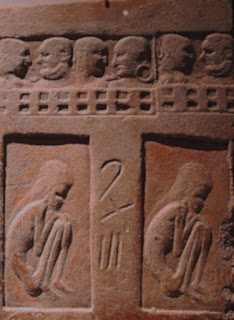
(A Harwan terracotta tile inside MET Museum, New York ...Photo by author)
The wider historical movement of
Jainism towards the north-west is well established. The noted American scholar
and art historian Pratapaditya Pal observed that, unlike Hinduism and Buddhism,
Jainism did not appear to have travelled overseas on a comparable scale to Sri
Lanka or Southeast Asia. However, he argued that both material and literary
evidence demonstrated that Jains travelled northwards by land as far as Kashmir
and Afghanistan in pre-modern times. This observation is of particular
importance because Kashmir was not isolated from the great intellectual and
commercial routes of northern India. It was connected through Punjab, Gandhara,
the north-western frontier and the Central Asian world.
Professor Muhammad Hameed of the
University of the Punjab (Pakistan) has also drawn attention to the evidence
for flourishing Jain communities and Jain religious and secular heritage in
Punjab and Sindh before the arrival of Islam. Jain historical sources refer to
communities in Sindhusagara, Bhera, Taxila, parts of Chakwal and other regions
of Punjab from a very early period. These notices are supported by Chinese
travel accounts and by archaeological investigations associated with scholars
such as Sir Aurel Stein and Sir John Marshall.
The importance of this evidence
lies in geography. Ancient Kashmir was not separated from these regions by an
impermeable cultural boundary. The movement of merchants, monks, scholars,
manuscripts and ideas between the Punjab, Gandhara and Kashmir was a continuous
historical process. Jainism therefore reached Kashmir through the same networks
that brought Buddhism, Brahmanical traditions, Central Asian influences and
various forms of philosophical debate into the Valley.
The Jain tradition itself
preserves memories of an early presence in the north-west. The oldest extant
reference to Jain political influence in northern India is associated with the
Hathigumpha inscription of King Kharavela of Kalinga, which refers to his
conquest of regions of the Uttarapatha in the second century BCE. Jain
traditions also associate Mahavira with journeys through northern India. Some
sources connect him with Shvetambika, identified by some scholars with the
region of Sialkot. Although such traditions require careful historical
evaluation, they demonstrate the geographical reach of early Jain memory.
The archaeological discoveries
at Taxila are especially significant in this context. Sir John Marshall's
excavations brought to light remains associated by some scholars with Jain
presence in the wider north-western region. Sir Aurel Stein also reported
remains that have been interpreted in connection with Jain establishments in
the region around the Jhelum. These discoveries form part of a larger pattern
of Jain movement across northern India and the north-west.
Kashmir's own textual traditions
provide further evidence. Kalhana's Rajatarangini is indispensable for any
study of the religious history of the Valley. It records the presence of
different religious communities and reflects the extraordinary plurality of
Kashmir's intellectual life. The Nilamata Purana also refers to worshippers of
Vishnu, Shiva, Shakti, Surya, Ganapati, Buddha and Jina. These worshippers are
identified respectively with Vaishnavas, Shaivas, Shaktas, Sauras, Ganapatyas,
Bauddhas and Jainas. Such a list is important because it places the worshippers
of Jina within the religious geography of Kashmir itself.
The most direct evidence occurs
in a celebrated verse of the Rajatarangini. Kalhana records that a Shravaka
named Ratna caused a beautiful image of Jina, Lord Neminatha, to be made on
Rajavataka hill:
तत्रैव राजवटके शैलेऽकारयच्छ्रावको रत्नः ।
मणिबिम्बं जिनेन्द्रस्य नेमिनाथस्य सुन्दरम् ॥
The verse may be translated as
follows:
(There, upon Rajavataka hill,
the Shravaka Ratna caused to be made a beautiful jewelled image of Jina, Lord
Neminatha.)
This reference is of exceptional
importance. It does not merely mention Jainism as an external doctrine. It
names an individual, Ratna, identifies him as a Shravaka and records his patronage
of a shrine or image dedicated to Neminatha, the twenty-second Tirthankara. The
date associated with this event is the tenth century, around 932 CE. This is
direct evidence of a Jain lay follower living in Kashmir and possessing
sufficient resources and religious commitment to establish a shrine or image.
The term Shravaka is itself
significant. It means a listener or disciple and ordinarily refers to a lay
follower of Jainism. In Kashmir's historical and literary records, the word
provides an important clue to the nature of Jain presence. Jainism in Kashmir
was not necessarily represented by a large territorial community or a powerful
Jain dynasty. It was more often embodied in individual Shravakas, merchants,
patrons, scholars and ascetics.
Three terms are particularly
important in understanding the references to Jainism in Kashmir. The first is
Shravaka, meaning a listener or lay disciple. The second is Jaina, meaning a
follower of the Jina and, by extension, of the Jain tradition. This term becomes
more prominent in later sources, including Persian accounts such as the Ain i
Akbari of Abul Fazl. The third is Nirgrantha, meaning one who is without bonds
or knots. This is an ancient term used in Buddhist and Sanskrit literature for
Jain ascetics and the Jain monastic tradition. Buddhist sources used the term
in connection with Mahavira and his followers.
These terms should not be
treated as interchangeable in every context. Shravaka generally identifies the
lay follower, Jaina identifies the religious affiliation, and Nirgrantha belongs
particularly to the older vocabulary of ascetic renunciation. Their occurrence
in historical and literary sources demonstrates that Jain communities and Jain
ascetics were known within the intellectual world of Kashmir.
The Jain presence was also
connected with Kashmir's extraordinary culture of learning. Jain historical
traditions record that the great twelfth-century Jain scholar Hemacandra sought
grammatical material preserved in Kashmir in order to prepare his celebrated
grammatical work, the Siddhahema. The Prabhavakacarita, a Jain historical text
dating from the late thirteenth century, is associated with this tradition.
Kashmir's Sharda tradition was renowned for the preservation of Sanskrit
learning, and the movement of texts between Kashmir and other centres of
scholarship demonstrates the Valley's position within the intellectual networks
of medieval India.
The presence of Jain scholars
and texts in Kashmir must also be understood against the background of the Valley's
multilingual and intellectually plural culture. Sanskrit was the language of
high learning, while Prakrit and other linguistic traditions were used by Jain
communities across India. Jainism made an enormous contribution to Indian
literary culture by adopting Prakrit as a vehicle for religious teaching and
canonical literature. The use of the language of ordinary people gave
extraordinary impetus to the development of Jainism also made major
contributions to Indian philosophy, education, art and architecture. Its
central ethical principle is ahimsa, or non-violence towards all living beings.
This principle is extended to the smallest forms of life. Jain discipline
therefore developed an exceptionally rigorous ethic of restraint. Even honey is
traditionally forbidden because its collection may involve violence towards
bees.
The Jain tradition is associated
with twenty-four Tirthankaras. The last was Vardhamana Mahavira, while the
first was Rishabhanatha or Rishabhadeva. Jain traditions connect Rishabhadeva
and Arishtanemi with ancient Indian religious memory, and names associated with
Rishabha and Arishtanemi have been discussed in relation to Vedic literature.
The Vishnu Purana and Bhagavata Purana also describe Rishabhadeva as an incarnation
of Narayana. The twenty-third Tirthankara, Parshvanatha, is traditionally
associated with Varanasi and is generally placed many centuries before
Mahavira.
Jainism is a religion of self-discipline
and liberation. The individual must achieve spiritual freedom through right
belief, right knowledge and right conduct. These are traditionally known as the
Three Jewels. The Jain path does not depend upon a creator deity who intervenes
to rescue human beings from the consequences of their actions. Liberation is
achieved through the purification of the soul and the destruction of karmic
bondage.
The two principal sects of
Jainism are the Digambara, meaning sky-clad, and the Shvetambara, meaning white-clad. Both traditions possess their own histories, texts and philosophical
developments. Jainism also places extraordinary emphasis upon reverence for
spiritual teachers, from the ordinary mendicant to the perfected Jina.
The religious diversity of
Kashmir provided a natural setting for philosophical interaction among such
traditions. The ninth-century Sanskrit play Agamadambara by Bhatta Jayanta is
particularly valuable. The work satirises different religious traditions and
reflects the complex religious and political environment of Kashmir during the
reign of King Shankaravarman, who ruled from 883 to 902 CE. Digambara and
Shvetambara Jain monks appear within the religious world represented by the
play.
The protagonist Sankarshana is a
young and dynamic orthodox student of Vedic learning whose intellectual career
begins with opposition to Buddhists, Jains and other heterodox traditions. The
very presence of Jain monks within this literary debate demonstrates that
Jainism was sufficiently visible in Kashmir to become part of the region's
philosophical and political discourse.
Bhatta Jayanta was also the
author of the Nyayamanjari and Nyayakalika. His work belongs to the great
intellectual culture of Kashmir, where philosophical debate was not confined to
one religious tradition. References to his Nyayapallava appear in the Jain
philosophical work Syadvadaratnakara of the Jain logician Vadideva. Such
intellectual connections demonstrate that Kashmir's philosophical traditions
were not isolated from Jain intellectual networks.
Jain influence can also be traced
in literary and devotional references. The Kashmiri Sanskrit poet Bilhana opens
his play Karnasundari with a Mangala Charana, an auspicious invocation, in the
form of a hymn to Jineshvara. This reference has been discussed in relation to
the history of Jain manuscript culture and literary traditions.

(Relevant page of Panchastavi...Photo by author)
The Panchastavi, an ancient
Sanskrit religious text associated with Kashmir, has been recited in Kashmiri
Pandit homes for centuries. The text was written in Kashmir and has remained
part of the region's religious memory. Its Kashmiri translation and the
reference in the Sakalajanani Stava to Jainendra or Mahavira being worshipped
alongside other deities are significant. The presence of Jina within a
religious vocabulary that also invokes Shiva and other divine figures reflects
the pluralistic character of Kashmir's religious world.
Lalleshwari, the great
fourteenth-century Kashmiri mystic, is also associated with a verse in which
the names Shiva, Keshava and Jainava appear together:
Shiva,
Keshava ha Jainava.
Whether the precise
interpretation of the term Jainava is debated or not, the occurrence of the
term in the textual tradition associated with Lal Ded is important. It reveals
that Jain identity and Jain terminology were not unknown in the religious vocabulary
of Kashmir.
The question of Ashoka and
Jainism in Kashmir has also occupied historians. Edward Thomas, in his 1877
work Jainism or the Early Faith of Ashoka, discussed the tradition that Ashoka
introduced Jainism into Kashmir before Buddhism became dominant. The
Rajatarangini contains traditions concerning Ashoka and his relationship with
the religious history of Kashmir. Later Persian historical traditions,
including the Ain i Akbari, also preserve the belief that Ashoka was connected
with the introduction of Jainism into the Valley.
These traditions must be
examined critically. The historical Ashoka is overwhelmingly associated with
the patronage and spread of Buddhism, especially after the Kalinga war. Yet the
Kashmir traditions concerning Ashoka and Jainism cannot simply be dismissed.
They may preserve memories of competing religious traditions, local historical
developments or later attempts to interpret Kashmir's religious past. What they
demonstrate with certainty is that Jainism had become sufficiently embedded in
the historical memory of Kashmir to be associated with the earliest phases of
the Valley's religious history.
The Jain presence in Kashmir
also appears in traditions concerning Sharda Peeth. According to a Jain
scholarly tradition, when Adi Shankara visited Sharda, he encountered Jain and
Buddhist monks and engaged them in philosophical discussion. Whether every
detail of this tradition can be historically verified, it reflects an important
understanding of Sharda as a centre of intellectual encounter where different
religious communities participated in debate.
The religious history of Kashmir
was therefore not a simple succession in which one faith replaced another.
Buddhism, Shaivism, Vaishnavism, Shaktism, Jainism and other traditions
coexisted, competed, influenced one another and participated in a shared
intellectual culture. Jainism remained a minority tradition, but minority does
not mean absent.
The Jain contribution to Indian
civilisation was far greater than its numerical presence in Kashmir. Jainism
contributed to philosophy, ethics, literature, education, painting,
architecture and manuscript culture. Its artistic achievements include the great
Jain caves and sculptures of India, the Jain monuments of Mount Abu and Girnar,
the Jain temples of Rajasthan and Gujarat, the Jain art of Khajuraho and the
monumental statue of Bahubali at Shravanabelagola. Jain painting traditions,
including manuscript illumination, represent one of the great achievements of
Indian art.
The Jain ethical principle of
ahimsa also possesses a special resonance in the history of Kashmir. Kashmir
developed its own traditions of philosophical refinement, spiritual discipline
and non-violence. The Jain insistence that every living being possesses value
and that liberation requires restraint, self-control and the renunciation of
violence belongs to the wider moral universe of Indian civilisation.
The later history of Jainism in
Kashmir reveals a gradual decline in its demographic presence. Before 1990,
more than forty-four Jain families were reportedly living in Kashmir. Today,
only a very small number of Jain families remain in the Valley, largely
concentrated in Srinagar and engaged traditionally in trade. The decline of the
Jain community is part of the wider disappearance of several ancient religious
communities from the Kashmiri landscape.
The disappearance of a community
does not mean that its historical presence never existed. Indeed, the
disappearance of physical remains makes the textual record even more important.
Much of the Buddhist archaeological heritage of Kashmir has vanished or been
damaged. Jain archaeological evidence is even more limited. Yet the surviving literary
material, scattered references, archaeological objects and memories preserve
enough evidence to justify sustained research.
The central conclusion is
therefore clear. Jainism was not a foreign doctrine merely mentioned in the
books of Kashmir. It was a lived Śramaṇa presence. Its adherents lived in the
Valley, its monks participated in religious and intellectual debate, its lay
followers patronised images and shrines, its scholars interacted with Kashmir's
great centres of learning and its religious vocabulary entered the literary
traditions of the region.
The evidence is necessarily
uneven. Some claims require further archaeological verification. Some
traditions belong to later historical memory and must be distinguished from
contemporary evidence. Some terracotta images remain difficult to identify with
certainty. Scholarly integrity demands that these distinctions be maintained.
Yet historical caution should
not become historical erasure. The cumulative evidence is too substantial to
ignore. The Shravaka Ratna of Rajavataka, the references to Jainas in the
Nilamata Purana, the Jain and Buddhist communities described in Kashmir's
literary world, the Digambara and Shvetambara monks represented in
Agamadambara, the Jain intellectual connections with Kashmir's centres of
learning, the memory of Jain presence in the Sharda tradition and the survival
of Jain families into modern times together establish a continuous historical
thread.
Jainism may never have been the
dominant faith of Kashmir. It did not create a great Jain empire in the Valley.
It did not leave behind a landscape of monumental temples comparable to those
of Rajasthan or Karnataka. But history must not measure presence only by
political power or monumental architecture. A religion is also present when a
person lives by its ethical principles, when a monk travels through a region,
when a merchant supports a shrine, when a scholar seeks its manuscripts, when
its doctrines are debated and when its name enters the literary memory of a
civilisation.
Jainism was present in Kashmir
in precisely this manner. It was a small but enduring strand in the religious
and intellectual fabric of the Valley. Its history remains insufficiently
studied, and a systematic investigation of Jain textual references,
archaeological remains, manuscript traditions, trade networks and oral memories
may yet reveal much more.
The task before scholars is
therefore not to manufacture a Jain past for Kashmir, but to recover the Jain
past that the evidence already indicates. The Valley's history becomes richer,
not diminished, when its religious plurality is acknowledged. Kashmir was a
land where many paths of spiritual inquiry met. Buddhism, Shaivism,
Vaishnavism, Shaktism and Jainism all formed part of this complex civilisational
landscape. Jainism was one of those paths. It was not merely remembered in
Kashmir. It was lived there.
In addition to the
sources already cited, the following works and institutions may be consulted
for a more systematic study of Jainism and the wider Śramaṇa traditions in
ancient Kashmir and the north-western Indian subcontinent:
(1)
Kalhana, Rajatarangini, especially the Sanskrit text and the
translations and annotations of M. A. Stein.
(2)
The Nilamata Purana, particularly its references to the religious
communities of ancient Kashmir.
(3)
Bhatta Jayanta, Agamadambara, for the representation of Jain and
Buddhist communities in ninth century Kashmir.
(4)
Prabhavakacarita, for the traditions concerning Jain scholars
and their connections with Kashmir.
(5)
Abul Fazl, Ain i Akbari, for Mughal period references to Jain
traditions associated with Kashmir.
(6)
Sir Aurel Stein's archaeological and historical investigations
in Kashmir and the north-western regions.
(7)
Sir John Marshall's archaeological work at Taxila and the wider
Gandharan region.
(8)
The Archaeological Survey
of India reports relating to Kashmir, Gandhara and the north-western regions.
(9)
The Annual Reports of the Archaeological Survey of India for
excavated sites in Jammu and Kashmir.
(10)
The Bulletin of the Asia Institute, including the study by
Pratapaditya Pal on evidence for Jainism in Afghanistan and ancient Kashmir.
(11)
The collections of the Metropolitan Museum of Art, the Ashmolean
Museum and the Los Angeles County Museum of Art, particularly their catalogues
of Harwan terracotta tiles and ascetic figures.
(12)
The writings of Paul Dundas on Jainism and Jain history.
(13)
Padmanabh S. Jaini, The
Jaina Path of Purification.
(14)
A. N. Upadhye and other scholars of Jain philosophy, history and
textual traditions.
(15)
Studies of Jain
manuscript painting and the western Indian manuscript tradition, including the
work of Ratan Parimoo.
(16)
Research on the history of Jainism in Gandhara, Taxila, Punjab,
Sindh and Afghanistan, since these regions formed the geographical and cultural
corridor connecting Jain communities with Kashmir.
(17)
Studies of the Śramaṇa
traditions of ancient India, particularly the relationship between Jainism,
Buddhism and Ajivika.
(18)
Research on the history
of Sharda Peeth and Kashmir's Sanskrit intellectual tradition.
(19)
Studies of Jain trade networks and merchant communities in
northern India, Punjab and the north-west.
(20)
Contemporary research by scholars of Jain history, Indology and
Kashmir studies, including the work of Professor Muhammad Hameed and Professor
Nalini Balbir.
A comprehensive future study
should bring these sources together with archaeological surveys of Kashmir.
Such research may be especially valuable at sites where religious identities
have traditionally been assigned too quickly. The Harwan terracotta tiles, for
example, deserve renewed interdisciplinary study involving art history,
archaeology, epigraphy and the comparative study of Jain, Buddhist, Ajivika and
Shaivite ascetic iconography. The history of Jainism in Kashmir is therefore
still unfinished. The evidence already available establishes a foundation. The
next task is to deepen it.
(
Avtar Mota )
PS
In 1973, a bronze Jain Tirthankara idol was stolen from the Shri Pratap Singh Museum, Srinagar, Kashmir. It was one of six antiquities taken in that theft, which also included bronze statues of Buddha, Tara, and Ardha-Narishvara. The Tirthankara was likely from the 8th–12th century, reflecting Kashmir’s Jain heritage during that period. As per official museum records, the idol has not been recovered and remains listed as missing.The bronze Tirthankara idol belonged to Kashmir.
( This essay is a registered copyright material published in Avtar Mota's book, 'Kashmir: The Crown Jewel of Indic Civilization '. available on Amazon )
.jpeg)


