


.jpg)




.jpg)


Sainte-Chapelle:
The Jewel Box of Gothic Paris
Tucked inside the Palais de la Cité on Île de la Cité, Sainte-Chapelle looks modest from the outside. Step in, and you
understand why it’s called a “reliquary turned inside out.” Built in the 1240s,
it was designed not as a Parish Church but as a Royal Chapel; a private stage
set for the most sacred relics in Christendom. For seven centuries, it has done
one thing better than any building in Europe: turn sunlight into story.
Why
It Was Built: A King, a Crown, and Power
The man behind it was King
Louis IX, later Saint Louis. In 1239, he bought what was believed to be the
Crown of Thorns from the bankrupt Latin Emperor of Constantinople, Baldwin II.
Cost: 135,000 livres, more than half the annual budget of France. Two years
later, he added fragments of the True Cross and other Passion relics. These
weren’t just holy objects. In the 13th century, owning relics meant divine
legitimacy. Louis wasn’t building a church; he was building a giant jewelled
case to prove France was the New Jerusalem. The chapel was consecrated on 26
April 1248, just before Louis left on the Seventh Crusade.
Architecture:
The Radical Idea of Walls of Glass
Sainte-Chapelle is Rayonnant Gothic, the
“radiant” phase of Gothic that pushed structure to its limits to maximise
windows.
Lower
Chapel:
Dark, low, painted with
fleur-de-lis on a deep blue vault. This was for palace staff and servants. The
ceiling is only 6.6m high. It feels like a crypt, preparing you for what’s
above.
Upper
Chapel:
Climb the narrow spiral
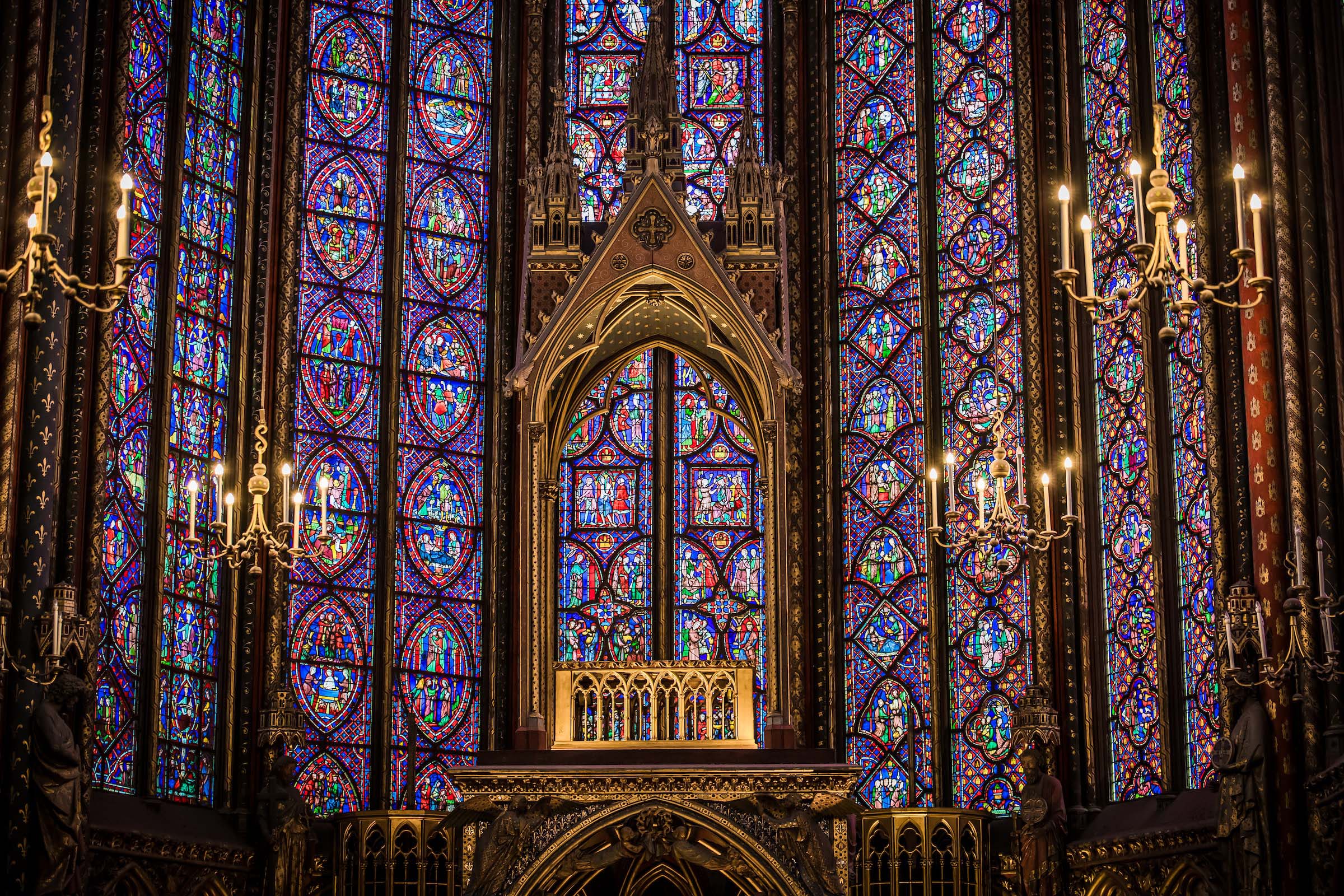
stair, and the space explodes. 15 windows, each 15m tall. The walls have
basically disappeared. Only slender stone mullions and iron tie-rods hold up
the vault 20.5m above. Of the 670 m² of wall surface, 618 m² is stained glass.
That’s 92% glass. The architect is not documented, but Pierre de Montreuil, who
worked on Notre-Dame and Saint-Denis, is the likely master. He pulled off an
engineering stunt: the buttresses are tucked into the exterior bays, so inside
you just see colour floating.
The
Stained Glass: A Bible You Can Walk Through
There are 1,113 scenes across 15 windows, read
left to right, bottom to top, like a comic book in light. It starts at the north wall with Genesis,
moves through Exodus, Numbers, Joshua, Judges, Isaiah, then the story of the
relics themselves. The east apse shows the Passion. The south wall covers John
the Evangelist, the infancy of Christ, and finally the Book of Kings, with Louis
IX himself shown carrying relics into Paris. The glass is “pot-metal”,, colour mixed
into molten glass, not painted on. That’s why the reds and blues are so deep
they feel physical. During WWII, the panels were removed and hidden. 720 of the
1,113 are still original 13th-century glass, the largest surviving collection
in the world. The Rose Windows were added in the 15th century under Charles
VIII, it shows the Apocalypse. At 9m in diameter, it faces west and catches
evening sun, flooding the chapel in violet and gold.
Damage
and Survival: Revolution, Floods, Restoration
Sainte-Chapelle nearly
didn’t survive.
French
Revolution: The relics were dispersed. The Crown of Thorns went to
Notre-Dame. The chapel became a flour clerk’s office, then a storage depot. The
spire was torn down. Mobs smashed the royal emblems.
19th-Century
Rescue: From 1840–1868, Félix Duban, Jean-Baptiste Lassus, and
Eugène Viollet-le-Duc led a massive restoration. They rebuilt the spire to 75m,
repainted the polychromy based on paint traces, and reinstalled the glass. Their
work is why it feels so complete today. Critics argue it's “over-restored,” but
without them it would be a ruin.
Modern Work: 2008–2015 saw
all 15 windows cleaned and restored. Laser work removed centuries of grime. The
difference is shocking; black blues are now cobalt again.
Symbolism:
Theology in Glass and Stone
Everything is intentional. Height: The 1:3 ratio of lower to upper
chapel mirrors Earth and Heaven. Statues:
The 12 Apostles stand on pillars; they are literally the “pillars of the
Church.” During the Revolution, six were smashed; the ones you see are
19th-century replacements. Light as God:
Gothic theology said God is light. Here, Louis made that literal. At midday,
the floor becomes a carpet of colored light. You don’t look at windows; you
stand inside them. Kingship: Louis
put himself in the glass, barefoot, carrying the Crown of Thorns into Paris.
Message: The king is Christ’s deputy on earth.
Why
It Still Matters
Sainte-Chapelle did
something no building had done: it removed mass. Gothic cathedrals are about
stone reaching up; this is about stone disappearing. Abbot Suger at Saint-Denis
started the idea that light = divine. Sainte-Chapelle finished it. It also
changed politics. After Louis IX, every European ruler wanted a relic chapel. But
none matched this balance, intimate enough to feel private, dazzling enough to
feel heavenly. John Ruskin called it “the most perfect piece of Gothic
architecture in the world.” He wasn’t wrong. Notre-Dame is power; Chartres is
majesty; Sainte-Chapelle is pure ecstasy.
Small
Details Most People Miss
In the apse, fleur-de-lis tiles mark where the
Great Shrine stood. The shrine itself, 10m tall in gilded silver, was melted
down in 1791. Look up at the spire. The “crown of thorns” motif repeats in the
ironwork. Clap once in the empty upper chapel. The echo takes 4 seconds to die.
Built for chant, not sermons. The reds and blues are not “medieval bright” by
accident. Analysis found traces of original pigment. The 19th century didn’t
invent it , they uncovered it.
The
Play of Light in the Sainte-Chapelle
The Sainte-Chapelle
represents one of the most remarkable achievements of French Gothic
architecture, distinguished by its innovative use of stained glass and light.
The lower chapel, through which visitors enter, evokes the atmosphere of a
crypt and is adorned with 140 intricately carved capitals featuring floral
motifs characteristic of the early thirteenth century. A staircase leads to the
upper chapel, originally designed to house sacred relics and connected directly
to the royal apartments. Completed in 1248, the upper chapel is renowned for
its extraordinary architectural conception as a space almost entirely enclosed
by approximately 600 square metres of stained glass rising to a height of
fifteen metres. Delicate colonnettes and rib vaults provide structural support
while minimising the visual presence of masonry, thereby creating the
impression of a luminous enclosure suffused with multicoloured light. This
masterful integration of architecture and stained glass exemplifies the aesthetic
and spiritual aspirations of the French Gothic period, transforming the
interior into a radiant sacred environment that continues to captivate
visitors. The visual effect is particularly striking on sunny days, when
coloured light floods the chapel, enhancing its ethereal quality and
reinforcing its reputation as one of the finest surviving monuments of medieval
stained-glass craftsmanship
Some
Practical Tips for the Visit
Located at Boulevard du
Palais, 75001. Inside the Palais de Justice complex, security is airport-level.
Bring a passport. The best time to visit is in the morning, 9:00–11:00, on a sunny day.
The light hits the east windows first. Winter sun is lower and more dramatic.
Around the solstices, the chapel glows. The ticket is in the range of 18–25 euros. We booked an advance ticket for 22 euros. Combo with Conciergerie saves money. Evening
concerts are held here. Hearing Vivaldi while the rose window goes dark is
unmatched. Crowds allowed in are restricted to a maximum of 200 persons at a time.
Arrive early to enter without standing in the queue, but summer lines still hit
one hour waiting in the queue.
Legacy
Louis IX died of dysentery
in Tunis in 1270 and was canonised 27 years later, the only French king made a
saint. His chapel outlived the monarchy, the Revolution, two world wars, and
the 2019 Notre-Dame fire. When Notre-Dame burned, the Crown of Thorns survived
because it was stored in Sainte-Chapelle’s sacristy that night. Stand there at
noon when the sun hits the Genesis window. The blue pours down and the whole
room hums. You get why Victor Hugo wrote that the Middle Ages were “naïve and
sublime.” For 45 minutes, you’re not in Paris. You’re inside a prayer made of
light.
(
Avtar Mota )

CHINAR SHADE by Autarmota is licensed under a Creative Commons Attribution-Noncommercial-No Derivative Works 2.5 India License.
Based on a work at http:\\autarmota.blogspot.com\.
No comments:
Post a Comment
Note: Only a member of this blog may post a comment.