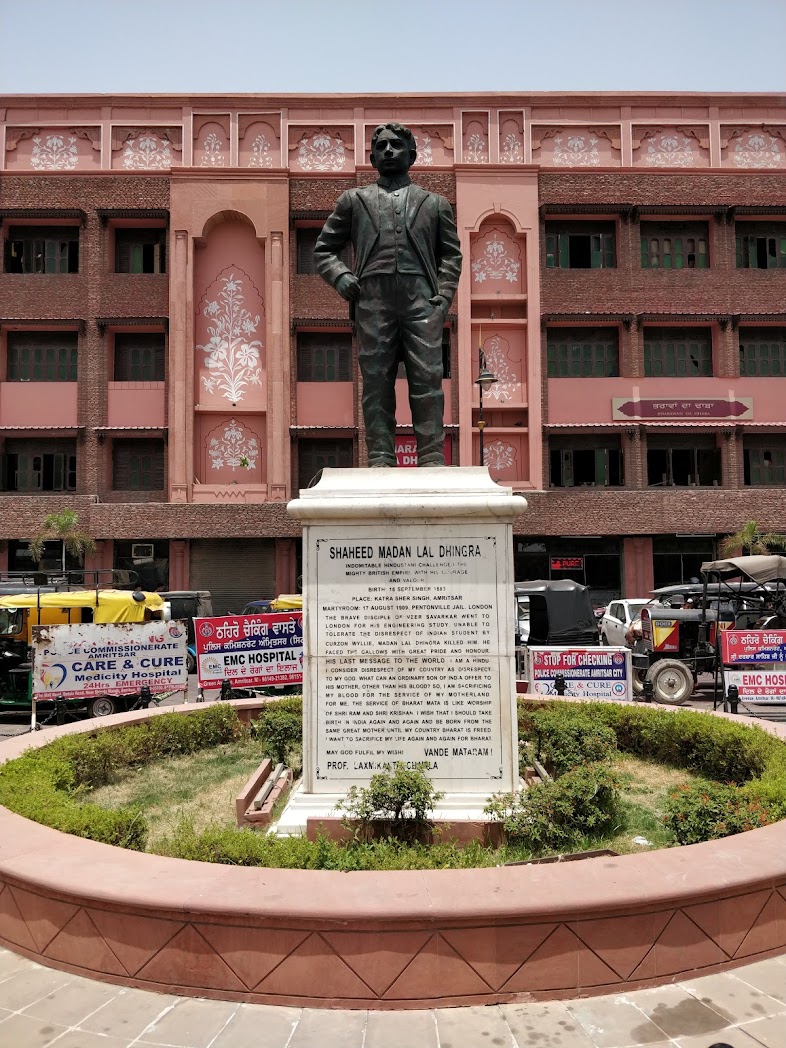
(Inter-State Bus Terminal Amritsar, named after Madan Lal Dhingra)
MADAN LAL DHINGRA AMRITSAR....
During my posting at Amritsar, I came to know many things about Madan Lal Dhingra, the unsung freedom fighter who was executed by British rulers on 17th August, 1909. Dhingra was studying mechanical engineering in the UK at that time. His father, Dr Ditta Mal Dhingra, was a reputed eye surgeon and CMO of Amritsar city who had been conferred the title of "Rai Sahib "by the British government. Dr Ditta Mal had luxurious Buggies driven by horses to ride. He owned the only imported car driven by an Indian in Amritsar city during those days. The Dhingras owned several houses in Amritsar city, apart from many Kanals of agricultural land in Sahiwal ( Sargodha district ), from where the family had moved to Amritsar.
Madan Lal had seven siblings: six brothers and a sister. Madan Lal’s eldest brother, Kundan Lal, had cordial relations with Sir Curzon Wyllie, an official of the British government who was eventually assassinated by Madan Lal Dhingra. Madan Lal Dhingra's brothers were highly educated. Mohan Lal and Behari Lal earned their respective degrees in medicine, Chaman Lal was a Bar-at-Law from London, Chuni Lal served as a Munsif in Jammu, Kundan Lal was a businessman, and the youngest Bhajan Lal pursued Bar-at-Law in London. Except Madan Lal, all the family members were staunch British loyalists.
While studying in Lahore, young Madan Lal got influenced by the "Pagdi Sambhal Jatta", a movement started by Lala Lajpat Rai and Ajit Singh, uncle of Bhagat Singh. In 1904, when Madan Lal Dhingra was doing a Master of Arts programme, he was barred from the college because he protested against the principal’s order to wear blazers made from imported cloth.
Dr Ditta Mal Dhingra did not like his son's association with revolutionaries of that time. A Fargati / disowning notice had also been published by the father in leading newspapers at that time. His father even stopped spending money on him, and Madan Lal did odd jobs to earn his living. He even became a Tongawalla and a labourer at Bombay port. Even under all these hardships, the flame of patriotism did not extinguish itself inside his soul. It now burned more vigorously.
His elder brother, who had become Diwan of Jindh State, brought him back to his father, who had already decided to send him out of the country to cut him from his revolutionary friends. After Young Madan Lal moved to the UK to study engineering, he got more involved in his revolutionary activities and the freedom movement of the country. In England, he got his focus on the freedom struggle tuned after meeting Shyamji Krishna Varma and Vinayak Damodar Savarkar.
Sir Curzon Wyllie had served the British Raj in various capacities during his stay in India. He was posted in Amritsar as well. He also served as Aide-de-Camp to the Secretary of State for India. In 1907, Sir Curzon Wyllie was part of a newly formed government committee to assess the political climate among Indian students in London. Curzon Wyllie identified India House as a negative influence on students and put it under surveillance. Concerned about his son’s involvement, Dhingra’s father urged two of Madan’s brothers in London to ask Curzon Wyllie, an acquaintance of the family, to use his influence to make him desist from such company. Latest research reveals that Sir Curzon Wyllie was the head of the Secret Police and collected extensive information about V. D. Savarkar and other revolutionaries in England. Dhingra had come to know that Wyllie had visited Paris to collect information on Savarkar and other activists, aiming to arrest or deport them. Dhingra also came to know that Wyllie planted spies, like an informer named Kirtikar, inside India House to report on revolutionary plans. This betrayal put Dhingra and his friends at constant risk of being caught. Wyllie had also started a “home for London Indians” to lure students and make them loyal to the British Raj. However, this fact was not mentioned in contemporary British media.
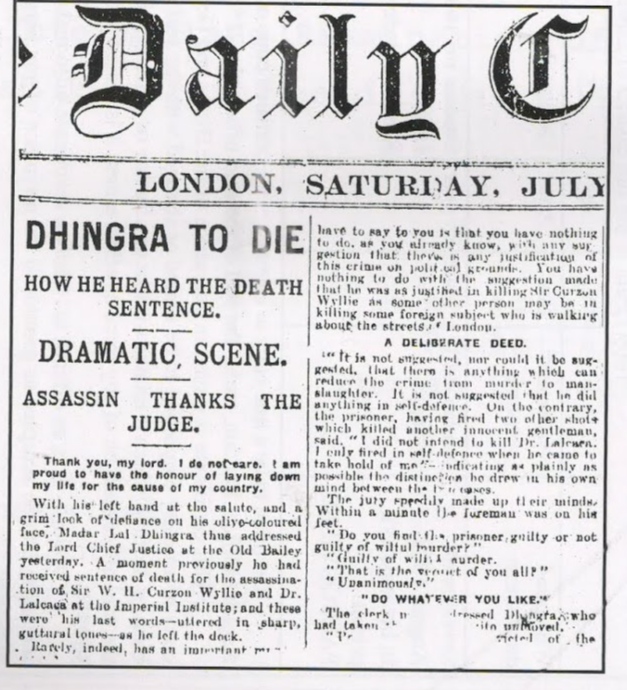
In 1908, when Khudiram Bose, Kanhaiyalal Datt and Satendra Bose were hanged, Dhingra turned restless and decided to take revenge. On July 1, 1909, Dhingra attended an “At Home” event hosted by the National Indian Association at the Imperial Institute in London. Wyllie was there, as he often attended such gatherings to keep an eye on Indian students. Dhingra, armed with a Colt pistol, fired five shots, four hitting Wyllie in the face, killing him instantly. A Parsi doctor, Cawas Lalcaca, tried to intervene and was killed by Dhingra’s sixth and seventh bullets. Dhingra was caught , tried and executed in London . His family refused to accept his body, and the family disowned him totally.
After Dhingra went to the gallows, The Times, London, wrote an editorial (24 July 1909) titled 'Conviction of Dhingra'. The editorial said, "The nonchalance displayed by the assassin was of a character which is happily unusual in such trials in this country. He asked no questions. He maintained a defiance of studied indifference. He walked smiling from the Dock." The last words spoken by Dhingra were as follows:-
"My only prayer to God is – “May I be reborn of the same mother and May I recite in the same sacred cause, till the cause is successful, and she stands free for the good of humanity and to the glory of God – Bande Matram.”
When Dhingra shot dead Curzon Wyllie, his brother Bhajan Lal was in London studying Law at Grey's Inn. Four days after the event, Bhajan Lal attended the public meeting to condemn Madan Lal. On account of that, Madan Lal refused to see Bhajan Lal when the latter visited him in the Brixton prison. Soon after their brother was hanged, his brothers dropped the surname Dhingra, except for Dr Bihari Lal. As their first names ended in Lal, they adopted that as the surname. e.g Chaman Lal Dhingra became Chaman Lal. ( In a similar manner, many Indian freedom fighters changed their names so that their relations would not be identified and harassed by the British authorities.
Almost all governments ignored this great son of Punjab. Even to this day, his own family members have not come out of this disowning mode. I have not heard them say that 'He made us feel proud'.
( Music Composer Madan Mohan and his wife Sheila Dhingra with their children )
Well-known music director Madan Mohan Kohli, or Madan Mohan, was always feeling proud of having been married to Dhingra's niece from Amritsar. Madan Ji would proudly declare his relationship with Madan Lal Dhingra's family from Amritsar. And Dr Ditta Mal Dhingra was a personal physician of Maharaja Partap Singh of J&K.
Madan Lal Dhingra's body was not given a cremation as per his religious beliefs but was hurriedly buried. Dhingra's coffin was exhumed on 12 December 1976 in the presence of Natwar Singh, then Acting High Commissioner for India. This coffin too was flown back to India.
It was P V Narsimha Rao ( The then PM of India) who took some personal interest and got a postal stamp released in his memory in 1992. In 2009, the Parkash Singh Badal government celebrated the centenary of Dhingra’s martyrdom. Capt Amrinder Singh CM (Punjab) held a grand function at Amritsar to commemorate Madam Lal Dhingra's martyrdom. The government also opened a park in his name near the new bus stand in Amritsar. The BJP coalition government installed an impressive statue of Dhingra in the heart of Amritsar city.
Shaheed Madan Lal Dhingra Smarak Samiti, headed by former health minister Prof. Laxmikant Chawla, has been mobilising opinion for the making of a memorial for the past many years. However, the government has yet to procure the land. The Municipal Corporation (MC), Amritsar, had initiated the process to procure the land where the real estate buyer from Amritsar had demolished the original house of the Dhingra family after purchasing it in 2012.
I conclude this post with my favourite poem, "Pushp Ki Abhilasha' written by Makhan Lal Chaturvedi...
( Pushp Ki Abhilasha...)
"Chah Nahin Mai Surbala Ke
Gehnon mein goontha jaaon
Chah nahin premi maala mein
Bindh, pyari ko lalchaaon
Chah nahin samraton ke
Shav par, hey hari daala jaaon
Chah nahin devon ke sar par
Chadoon, bhagya par Itraoon
Mujhey tod lena banmaali,
Us path par tum dena phaink
Matra bhoomi par sheesh chadaaney,
Jis path jaayein veer Anek."
(Makhanlal Chaturvedi...)
My English rendering would be like this:
(A Flower's Ambition )
(Never do I desire to become
the part of a celestial nymph's jewellery,
Never do I desire to be a part of a lover's garland,
To allure and tempt my beloved with my charms.
Never do I desire to be a part of the wreaths placed on the bodies of emperors and monarchs.
Never do I desire to be used to decorate the heads of deities and gods,
and feel proud of my good luck.
O Gardner!
pluck me and throw me on the path
trodden by many brave and courageous soldiers
on their march to sacrifice their lives for my motherland .)
(Avtar Mota)

 CHINAR SHADE by Autarmota is licensed under a Creative Commons Attribution-Noncommercial-No Derivative Works 2.5 India License.


.jpeg)