Monday, May 31, 2010

SOME FORMS OF CLASSICAL MUSIC OF KASHMIR

“MALAAL TRAAVITH TSE SAAL IKH NAA
BAA PYAAL MUSS KE BARAY HAA LAALO.
KHAYAAL CHAANEY ME DIL CHHU TOSHAAN
BAA MAAL POSHAN KARAY HAA LAALO”.


(Forgetting grievances , Love come this way
I invite you. I shall fill cups of wine in thy honour.
I pain even when I just think of you love !
Come, I shall welcome thee with garlands of flowers Love !"

The Hafiza Danced on this beautiful kashmiri poem of Mehjoor .I enjoyed watching two Video CDs sent to me by Tej Dhar my friend and colleague in the bank .That was possibly a Programmee titled Dance and Music of Kashmir produced by very talented media Personality Pran Kishore . I could read the footage of the Video CD depicting its presentation in Pune. Pran Kishore , Broadcaster, actor , Theatre director , script writer for TV serials and films ,a multifaceted personality and so is his wife Shanta Koul . .I also saw two girls singing GUNGA NAWA DIL JAANE TE MERIYE GUNGA NAWA in these Video CDs. Our elders sang this Kishtwari song. I also saw Sangeet Natak Academy Awardee Ali Mohd Sheikh singing some memorable kashmiri songs in this CDs. Pran ji presents RAUF, CHAKRI, VANVUN , SUFIANA NAGMA, BACHAA NAGMA , HAFIZ NAGMA ,EID RAUF and many more items showcasing the best forms of kashmiri dance and music. Music composer Kishen Langoo confirmed that he had scored the music for this specific programme of Pran kishore and a lot of labour had gone in to the making of this Programme.

Thank you PRAN KISHORE JI AND KISHEN LANGOO JI for this superb artistic work. I gave a copy of this CD to a Non kashmiri General Manager of our Bank who later confirmed having enjoyed each item primarily on account of Pran Ji’s superb ENGLISH commentary all along..That confirms to me that good music has a universal language.


Essentially SUFIANA MOUSIQI ,CHAKRI , HAFIZ NAGMA , ROUF and VANVUN can be said to represent the classical music of kashmir .


Chakri
Once performed with the help of only Noet ( Matkaa), Sarangi and Rabab, Chakri has included harmonium also in its presentation. It is one of the most popular forms of the traditional music of Kashmir.

Sufiana Mousiqi
Sufiana Mousiqi( Music ) is the classical music of Kashmir, which uses its own ragas (known as maqam), and is accompanied by a hundred-stringed instrument called the santoor, along with the Kashmiri saz, wasool, tabala and sitar. Sufiana Kalam has been popular in Kashmir since arriving from Iran in the 15th century and has been the music of choice for Kashmiri Sufi mystics. The dance based on the sofiyiana kalam is the hafiz nagma.Woman who dances on this Sufiana Kalam is known as HAFIZA . Ustad Gh Mohd Saznawaz is the greatest and perhaps the only singer of this style of Music in the world .One must hear "Boazu Myaan Zaar - Zaaray e Paar _ Awaara Kar Thuss . " "Listen my woes - Listen my requests . I am undone and roaming aimlessly in thy love. " From this ustad . You get transported to another world.Ustad sings Muqaame Naorez e Sabah , Muqam e ark, Muqam e Junjoti , Muqam Asfhan ( Khamacha ) , Muqam e Awazal and Muqam Bayat in his own Unique style..


Hafiz Nagma

A part of the classical Sufiana Music, Hafiz Nagma makes use of Santoor-a hundred stringed instrument played with sticks. In Hafiz Nagma, there is a female dancer, accompanied by a number of males with instruments. The dancer, known as Hafiza, moves her feet to the musical notes.


Rouf
Rouf is the oldest form of kashmiri dance and it is performed by women.Two groups of women facing each other move their steps forward and backwards in rhythm with the notes of the song accompanying this dance .
vanvunn
This is the oldest form of singing in kashmir. Both Hindus and Muslim use this style mostly in marriages .Vanvunn is sung by ladies only.


So Long so much for this post.


CHUVV SUKRAATUNN CHUVV AKH DHAAM
TUNAA CHUVV ASSI BOAD DAL AZ TAAM..
( Dina nath Naadim )

”Socrates just drank a single gulp of the poison,
Since then we drank equivalent to the
volume held by bigger Dal lake ”

( Translation autar mota )

Creative Commons License
CHINAR SHADE by Autarmota is licensed under a Creative Commons Attribution-Noncommercial-No Derivative Works 2.5 India License.
Based on a work at http:\\autarmota.blogspot.com\.

Saturday, May 29, 2010

WHEN FAIZ AHMED FAIZ TALKED ABOUT THE GREAT POLISH COMPOSER FRYDERYCK CHOPIN

A friend of mine has asked me what does faiz mean in the poem

“SHOPAIN KA NAGMA BAJTAA HAI ”

My reply is as under .
Yes Faiz wrote a beautiful poem under this title . some lines that I remember are


Chhalnee hai andhere kaa seena
Barkhaa Ke Baale barsein hain
Deewaron Ke aansoo hain Ravaan
Ghar Khaamoshi Me Doobein hain
Paani Me Nahaaye boote hain
Galiyon Me Hoo Ka Pheraa hai

SHOPAIN KA NAGMA BAJTAA HAI .

Gham Ke saanche me Dhaala hai
Ek Baap ke pather Chehre ko
Ek Murdaa Bete ke maathe ko
Ek maa Ne ro kar Chooma hai

SHOPAIN KA NAGMA BAJTAA HAI .

Phir Phoolon Ki Rut Laut Aayee
Aur chaahne walon Ki garden
Me Jhoole Daale baahon Ne
Phir jharne naache Chhan Chhan Chhan
Ab Baadal hai na Barkhaa hai

SHOPAIN KA NAGMA BAJTAA HAI


FRYDERYCK CHOPIN ( 1810-1849 whom Faiz calls Shopain) was a master composer from Poland who rose to the stature of Mozart and Beethoven . He composed some works for the Piano which made composer Schumann write “ Hats off to this genius ”. Chopin’s Music is forever fresh and relevant. It is tender , happy and sometimes loneliness personified .Like John keats , he too died of Tuberculosis .His imposing statue can be seen in WARSAW . Faiz also liked Piano music and had profound knowledge of western classical greats like Bach , Beethoven and Mozart. This poem is  celebration of the universal appeal of Chopin’s music . His music goes on in rains , in sorrow and in meeting of lovers .That is what the poem conveys .

Creative Commons License


CHINAR SHADE by Autarmota is licensed under a Creative Commons Attribution-Noncommercial-No Derivative Works 2.5 India License.
Based on a work at http:\\autarmota.blogspot.com\.

Wednesday, May 26, 2010

NAA KAHOO SE DOSTI NAA KAHOO SE BAIR

 Prof. Ishtiaq Ahmed teaches political Science at University of Stockholm.I keep reading his books and Articles . I find this learned man Authentic, original and without any bias of race or religion. His articles are well researched . 

Long back I heard a lecture by Sri Ranganathananda a very respectable Monk of Rama Krishna Mission wherein he described the conduct of a present day intellectuals. This learned sage also talked about the conduct of present day executive who is required to manage men in any organization. Though Far from management theories of Peter Drucker ,I found the discourse of this Monk inspiring and practicable .It kept the listeners spellbound. Sri Ranganathananda was also of the view that every modern executive should essentially deal the problem and not the person . Infact every humane and sincere solution to the problem shall finally reach the person .An executive should never reach a problem through a person alleged to be the cause of it. This great thinker was also of the view that it is essential for an executive to put in practice the lines of great saint Kabir

KABIRA KHADAA BAZAAR MEIN SAB KI MAANGE KHAIR 
NA    KAHOO    SE    DOSTI   NA   KAHOO   SE   BAIR.

Coming to Prof Ishtiaq Ahmed , I find that he follows the dictum of Sri Ranganathananda in all his scripts essentially NA KAHOO SE DOSTI NA KAHOO SE BAIR ..He touches subjects and issues in total objective manner. He is a master in looking at (and presenting ) some of the conflicts both past and present in the light of cause and effect theory. . Such presentations evoke sympathy for the persons who are being talked about. They appear to be victims and effects of a cause . None of them is a cause for the issues under discussion. That appears wonderful. I call it information management. 

During my School days we were told by our teacher Pandit Dina Nath Hanjura that some Hindus also joined Imam Hussain ( PBUH ) in fighting evil forces of Yezeed at Karbala . These lines remained etched in my memory. None could confirm this to me though I was sure that a saintly man like Pandit Dina nath Hanjura would never tell a lie nor say something which had no Base. Thanks to Prof Ishtiaq Ahmed. He confirmed this to me . I lately read his book on Lahore covering tragic events of 1947 titled “  Lahore 1947- Some first person accounts .”. At page 35 i found the facts confirmed by Veteran Journalist Jamna Dass Akhtar a journalist to prof . Ishtiaq. I quote Jamna Dass akhtar 

“ We are known as Hussaini Hindus . Hussaini Brahmins were found in many places in the Rawalpindi division .One of our ancestors Sidhu Dutt and his seven sons died fighting on the side of Imam Hussain at Karbala.” 

Beautiful. Hindus joining Imam Hussain (PBUH) and fighting evil forces . The book is based on some first person accounts narrated to Prof Ishitiaq Ahmed or his brother . 
I wish the learned professor a long life to enable him to contribute his thoughts to the pool of information for our posterity . I also wish peace to the soul of Pandit Dina Nath Hanjura our school teacher.
Autar Mota 


Creative Commons License

CHINAR SHADE by Autarmota is licensed under a Creative Commons Attribution-Noncommercial-No Derivative Works 2.5 India License.
Based on a work at http:\\autarmota.blogspot.com\.

Friday, May 21, 2010

HUKH , HATAB , KOSH AND STOVE

Creative Commons License
“Bobu Ji Hukh Chhu Aamut. Patta mokalee . Buthee chhuyee Krooth Vandhaa ”


“Pandit Ji Hukh is available now . It shall be sold immediately . You have to face severe winters” .


said Ali Mohd MuttHanz to my father .
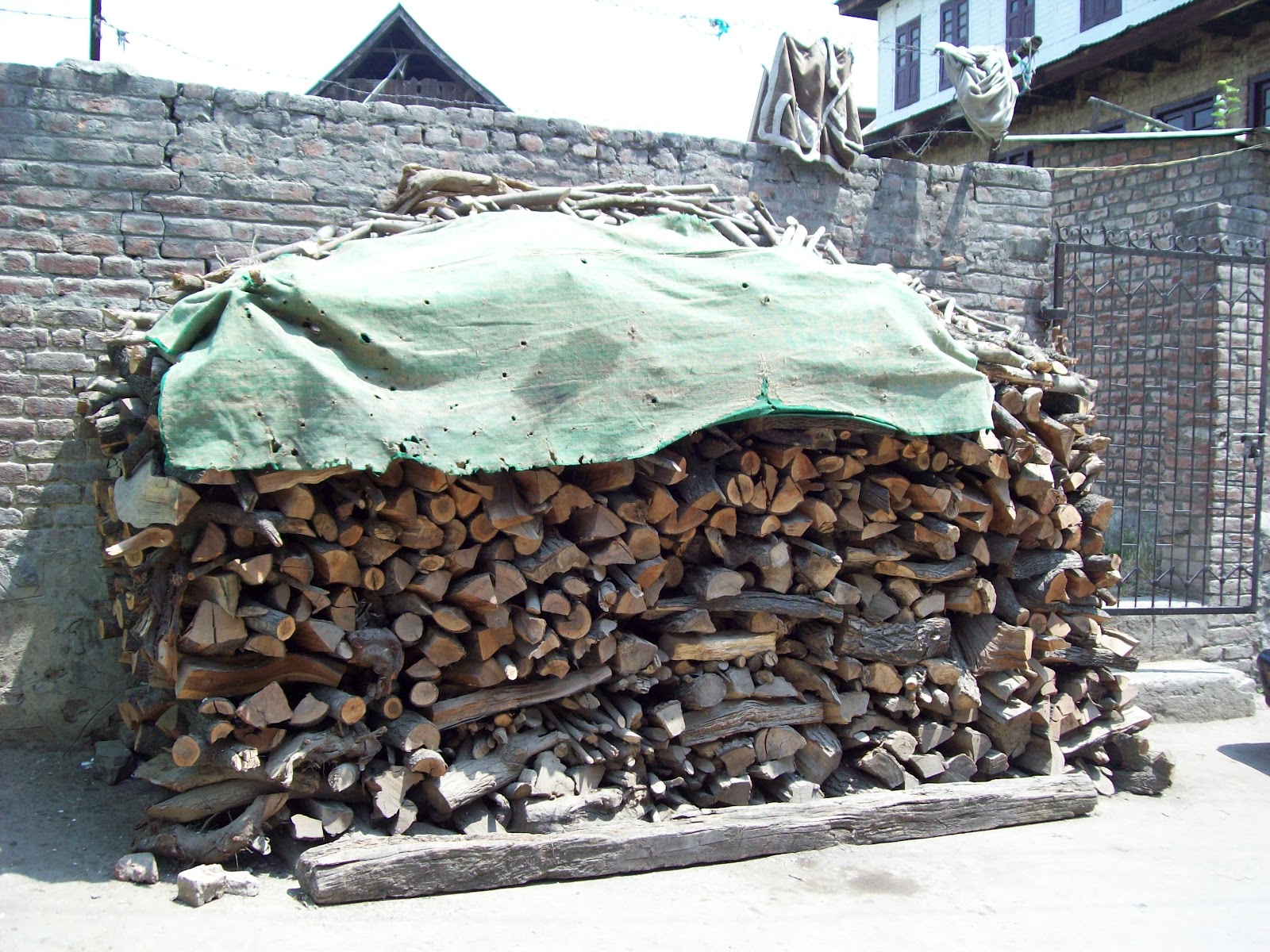
We went to Kraalyaar Maar ( Canal ) and Purchased two quintals of Hukh for the winter. Hukh was collected from rivers by a group of Boatmen and then brought to city for sale in big boats called Bahach. Hukh consisted of pieces of wood collected from rivers and loaded in boats for burning in Kitchen during winters . It made the kitchen warm when burnt in DHAAN ( CHULHAA ) by our womenfolk .I would sit in the kitchen only to have my food when my mother burnt HUKH for cooking food in the Kitchen . She would also burn a stick of Willow or Conifer or Deodar along with HUKH pieces .Seeing the Hukh in the DHAAN ( CHULHAA ) gave a very good feeling to me . We would come to the kitchen repeatedly to fill our Kangris . The kitchen turned cozy and warm with HUKH burning .Some families used cow dung in place of Hukh .I also noticed how skillfully my mother used to make Coal from the Burning HUKH or firewood in the kitchen. She had kept a LEJJ ( earthen pot ) with a lid in the Kitchen .She would be removing Burning Coal heaps from the DHAAN ( Chulhaa ) and throwing them into the LEJJ and then immediately replacing the lid . The burning charcoal would cool down and the coal so prepared would be used by her to make the afternoon or evening Tea for the family.


In so far as the timber was  concerned , its procurement from the Government Timber Yards spread all over the city was  a tough job. You had to get up in the morning and keep your CHENDHEE ( Timber cards supplied to each family by Forest department ) near the window of the Zeun Ghaat ( Timber depot ) to procure timber on government rates. Generally milk selling families supplied the labour force at these timber depots . A labourer would even carry 100 Kgs of Timber log on his shoulders . Then he would suddenly  throw the log with a bang in the courtyard making windows rattle . Now the TABARDAAR( wood cutter ) would come and cut these logs to pieces for ultimate use in the kitchen . We would then carry the pieces for storing them at a safe place .HATAB ( A Variety of Timber used for burning ) was a preferred stuff  by kashmiris. I vividly remember kashmiris keeping a vigil on arrival of HATAB at timber Depots to buy it . It produced a quality heating fuel for the Kangris .


Another fuel with kashmiris was the saw dust popularly known as KOSH. They would use it in kangris and more specifically for boiling water to wash clothes . Every sunday we would use KOSH  DAMCHULAA ( special mobile chulhaa made of iron for burning saw dust ) for boiling water to wash clothes . It produced irritating smoke . The burnt saw dust was also used in kangris . For bathing we had  a special iron HAMAAM which used to give instant boiling water once firewood was burnt inside it . Timber from POPLAR trees sold by band saw mills was  burnt in this HAMAAM .. This timber was called MOCHAA or left overs ( scrap ) of the Band saw mills where POPLAR logs were sawn to  sheets ..


Many families  had Kerosene stoves . My father  had  also purchased two Kerosene stoves for our kitchen   . Triloki Nath Pandit  whom every one called as Treyaa Pandit or Treyya Tsoor  and   who reportedly had some criminal past ( in plains of the country) had opened a stove repair shop in Jogi Lanker chowk . His shop was near police station Rainawari  just opposite to  the shop of Chuni Lal Watloo.  Chuni lal watloo had a small  drug and medicine shop where pandits would sit for gossiping  . These gossiping Pandits made Chuni lal Watloo lose all customers .When Newer Drug and medicine  stores   opened in  Jogi lanker  Chowk , Chuni lal Watloo  shifted his activity    to a newer trade and started working  as an  agent of the Police officials   in  the nearby Police station . Any person who had to lodge an FIR or needed Police assistance had to come to Chuni Lal watloo's shop  for  direct or indirect help from the police  . 


Now coming to Treyya Pandit's shop of stove repair ,Every time I went   with our  stove to him, he would just change the burner . He did it to all stoves coming to him . For him change of burner perhaps solved all problems of a stove .He did  so even for Minor Blockage  in the kerosene passage of the burners which could be easily   cleared by a   stove pin.  Perhaps he knew nothing else  and also it made him earn instantly.  His customers paid without any arguments.


Then came the LPG Era . Kashmiris immediately shifted to LPG DHAAN (CHULHAAS).  We had to face Long queues at Jawahir nagar office of JAKFED wherefrom we would purchase the gas  Cylinder refills . Kashmiris  quickly forgot the age old trsted and tried fuels like HUKH , HATAB , COWDUNG AND KOSH ( saw dust ) .


 I end with a quote of camus :

 “You will never be happy if you continue to search for what happiness consists of. You will never live if you are looking for the meaning of life.”
 (Albert Camus )

So Long so much .

visit me also at    
http://yemberzalkashmir.blogspot.com/

CHINAR SHADE by Autarmota is licensed under a Creative Commons Attribution-Noncommercial-No Derivative Works 2.5 India License.
Based on a work at
http:\\autarmota.blogspot.com\.

Thursday, May 20, 2010

WHERE HAVE THE WORKERS GONE?

“You do one thing . You take this table and keep it over there . Bring that chair here.

Said Makhan lal Ji  to me in that marriage . It was perhaps   June 1978. We had been  awake   for the whole night  busy in   making arrangements for the BARAAT  of  the  sister of one of our friends.  At that  particular moment, We were decorating the lane leading to the Shamiyaana  with Buntings made of kite paper  . Makhan Lal ji came at 8AM on the BARAAT  day well dressed  with a  neck tie. His shoes were shining like a mirror. He was a close relation of the family  .
It was pretty common in Kashmiri families that such like people would come just one hour  before  the BARAAT arrival  time and start directing workers essentially to make their presence felt or give an impression to one and all that they too had  joined the group of workers or arrangement makers .I always noticed them in marriages . We used to call them “ YOU DO ONE THING ”.To my surprise I found them in marriages of my Muslim friends also .

Marriages in Kashmir used to be a tough job not only for the family of bride or bridegroom  but also for the relations and  more essentially for the neighbours . People would Pitch a Shamiyaana at a convenient   open space in the Mohalla . Young boys from the Mohalla would join as workers .  Relatives would also send  work force  from their families. The workers shared space and food . It was a time to make new friends .  Marriage halls or Banquet Hall culture was  totally absent in Kashmir valley.

In Rainawari , We would collect the cooking utensils and  beddings  in a  roof less Boat( Locally known as Demb Naav ) from various families. A diary was needed to enter them with specific  identification marks so that it was easy to identify these  items  at the time or return.  I vividly remember having noted identification marks like RNK ( Rugh Nath Koul ) GB( Gup Bhat ) DKK ( Dam Kaak kachru ) written on the rim of  Brass Utensils   popularly called  DEGHCHAA  .The tent house man would bring Thaalis , Glasses , Gas Lamps ,Chairs , Tarpaulins , flooring  and other items . He would also bring standing makeshift wash basins  which always leaked . A group of  workers would always be there  to share any responsibility smilingly.  
  
  Marriages  were mostly held during daytime. For office going guests , meals were ready at  8AM . Guests were  made to sit  for eating   . White sheets spread systematically would determine the sitting arrangement . Workers would enter the shamiyaana and help the guest to wash their hands . This was followed by distribution of Thaalis( Eating Plates ) . Then one worker would come for cleaning the Thaalis with a fresh  piece cloth  . Suddenly you found a battery of workers  trooping into the Shamiyaana and serving dishes and rice . Lastly the cook would come barefooted with an earthen Pot known as LEJJ  to serve Cheese cooked  in turmeric known as Kalee. For a non vegetarian  feast ,Mutton kalee Would be served last of all. The cook would blacken the white sheets upon which guests ate with his foot impressions while moving to serve guests .Women would drag workers and request them to put more dishes in Thaalis of their relations to whom they were supposed to play host  .They would say:-

“Traav Yemis ”
“ Put in this Thaali ”
“Akh Garam Bhatah  Phoal ”
“ Just small quantity of  hot rice ”
“ Saibaa Kyaazi Aav Na ”
“Why did not Saiba come ”
“Amma ji  Khaatireh Nizi  Dabuss Munz Me Thovmai Kuthis Munz Khaarith .
Kaansi Vanizi naa ”
“For Amma ji I have kept the food in a box. Take it silently to your place when you leave .”
“ Waza hayee chhukh  Sham Lal . Kraal khod Baithak Pyaath Onmut.   Chhunai Theek Ronmut ”
“ The cook is sham lal  from Kraal Khod  Habba kadal Baithak. Has he cooked well ”
Serving to women guests was a tough assignment for the workers  . They made frequent demands to workers . Some time they would ask workers to keep vigil on their sandals . Some women would take food sitting on their sandals lest they be stolen.


Workers would be there  serving in Menhdiraat , Baraat  Reception , Gar Achunn and Yagneopavit  Functions . The would be there when  the bridegroom would come to his inlaw’s house first time after the  marriage. This function was   known as PHIR SAAL.He would also carry children of his close relation with him . I also knew a good number of persons who were known as DUDDA or uninvited guests. They would be seen in all marriages .They would enter with confidence and eat to fill.  Workers would recognize them and smile while serving them .A  DUDDA only entered the Shamiyaana after carefully befriending  the workers .My father has told  me that there used to be a DUDDA known as KASHI NATH . He was  known as Kashi Dudda. Kashi Nath belonged to a well off family but the DUDDA Impulse made him to dress up and rush to  Feasts uninvited .One day he went to the marriage  function of DHAR family of SAFA KADAL   thinking that the feast would be lavish and none could recognize him . It so happened that the Host  while welcoming  him , asked him if  he belonged to Munshi family. Kashi nath was trapped . But here he cleverly replied  as under

“ Dhar sahib I am from the Miscellaneous ( MUTFARQAA ) list . Remember when you and your wife were preparing the list of guests for  invitation , you kept 50 guests as Miscellaneous  ( MUTFARQA) . I am just one from that list .”

Where have those workers gone ?

I end this post with some more childhood songs which i still remember . Here they go


1
Yuss laagi Tuss Laagi Sarkaari 
Maharaj   Saabin Zimavaari 

2
Budaa Budaa Vothu Vaen 
Ba  Vothai  Naa 
Soan Sundh Poand Dimai 
Ba Vothai Na .
3
Sheena Pyeto Pyeto 
Maama Itto Itto .

4
Bukka Bukka Aaab Khaasie Asmaanuss 
Yuss me Vohavee  Tuss   panuss.

5
Sheen Heytunn Waalunn ,
Assi Chhunnaa zaalunn ,
Gachhav sonaa Shawlunn,
Push Heymoss Vaalunn,
Sui Heymov Zaalunn..
6
Gaash Broar Aav
Daari Kin Tsaav
Ratuss Rotun Yeti hay ,
Poshaunn Kariss Foet Hay,
Tim Kuss kitt hay ,
Lal Saabuss kitt hay.


.

CHINAR SHADE by Autarmota is licensed under a Creative Commons Attribution-Noncommercial-No Derivative Works 2.5 India License.
Based on a work at http:\\autarmota.blogspot.com\.

Thursday, May 13, 2010

SOME SONGS OF MY CHILDHOOD

Creative Commons License


“Come put your feet under my Pheran. I shall rub them . Do not use Kaangri ”

Said my maternal grandfather to me . I went to him complaining sudden redness and pain in one of my toes. He said “ Ye Chhuyee Shooh Gomutt. ” Meaning this is frostbite . With his rubbing , I felt  warmth and a little comfort. The pain turned mild . I heard him singing in kashmiri

“Bisht Bisht Braaryo
Khotakho Vunn .
Torraa kyaah Voluth
Babri Punn.
Su Kamunn Chhokuth
Kottarunn.”

I do not know when I slept and where the pain went . May be the  lines of the song had played their role effectively. This and many similar songs were meant for children . I was always amused when I heard some one singing them. Whenever I played with my Maternal cousins , we would sing

“Raaja Bhaai Raaja
Kyon Kotwaal
Srinagar Me Chor Aayaa
Kiss Raaste
Iss Raaste”

A cousin sister of mine would play with us and sing

Okuss Bokuss Tillwaien Tsokuss,
Onumm Batukh Lodhum Deghee,
Shawl Kich Kich Wangno.


I am certainly talking of a period when only some families had the privilege of having the radio sets or transistors . My Father had bought this luxury for us . Radio Ceylon with Amin Sayani as the announcer was quite popular. I still remember the advertisement for LOMA hair oil. Television was totally unheard of . We did remember many hindi songs but friends in school and my cousins would frequently sing the kashmiri children songs while at play. Money was a scarce commodity. The state government clerks would be offered a special selection grade on promotion satirically  still known as Rs 70-6-130.  we had a community radio set  in Jogi Lanker chowk . Generally people would come out and listen to news over there.  I remeber some boys in our locality singing

“Kaav Butt Kaavo
Khechri Kaavo

We had a teacher in DAV school Rainawari Radha krishen By name . He was Tall and would spend some time in his class on issues not connected with studies . He would ask two boys to get up and do “GUFTGU ”. The boys were supposed to curse each other in choicest words or call nick names . Entire class and the teacher would join them with  their sadistic smiles on this  so to say one act play .One day I heard Radah Krishen  saying

“Tsrind Grindumm Te Mong Daal


Okhun sahibuss Khatan Haal ”

I did not know the meaning of these words but they some how caught my fancy . later I heard many relatives also using these lines while playing with their children. The lines actually mean that a teacher( Okhun ) is generally poor . So When he performs circumcision of his child he just cooks Daal and ordinary food. No Mutton or lavish dishes .These songs had enormous effect on young minds  . Mothers would lull their babies to sleep with these songs. These were sung by children while playing . Elders would humour them with young kids. No Kashmiri  of my age  can say that he does not know them . Some other songs which we used to sing as children are


Habba kadal loraan
Zaina Kadal Ladhaan
Bisht Mouj vadhaan


Hop Lop Chhop Kurr
Mauj Gayee Greit bal,
Torra anni Saut Pull
Audd thaav Chunduss
Su Poshee Vanduss
Audd  Thaav Aaliss
su Poshee Reit kaaliss


In DAV school ,We had a class fellow whom we called Nikka Razdaan .He would sing Ladee Shaah . Here goes what he sang


LadeeShaah Ladeeshaah  Daari  Kin  Pyaav
Pyaavanai Pyaavanai  Haaptunn  Khyaav .
Budd  Mauj  Budd  Mauj  Kenh Nai  Guvv
Tse  tulum  Trum Tai  Baa  Tulai Nai
Vataan  vataav  Naavid  Khai
Bakshi  Sahib  Naavi  Munz  Saer  Karaan
Musaafir  Aayoss  Bataah  Mendiss
Chonch  Dhubb  Loynuss  khor Tendis .

Somtimes our neighbour Ritch Maal would come to our house and gossip with my mother . Once I heard her singing smilingly


Tul Paluvv Tul Paluvv
Voth Tseluvv Voth Tseluvv
Baani Haali Buth Chhaluvv.


My sisters studied in Vishwa Bharti college Rainawari. I vividly remember them saying that a person by name Sarva Nand had a shop in the college and many girls would tell him

Sarvananduss  Kokur  Chanduss
Vanduss  Karaan  kuk Du Koon.

These lines always created a desire in me to see Sarvanand Physically . Alas I could not

On shivratri day I would wait curiously to see my mother with  a pitcher full of walnuts (soaked in water ) on her head knocking our main door and singing

Thuk Thuk
Kuss Chhuvaa.
Raam Brorr
Kyaah Heuth
Anna Heuth
Dhann Heuth
Roozi Heuth
Rozgaar Heuth .
Ghar Heuth
Gupan Heuth
Nosh Heuth
Koor heuth
Munz  Kuss Chhuv
Shiv Naath Te Paarvati


So long so much .
visit me also at  http://yemberzalkashmir.blogspot.com/

CHINAR SHADE by Autarmota is licensed under a Creative Commons Attribution-Noncommercial-No Derivative Works 2.5 India License.
Based on a work at http:\\autarmota.blogspot.com\.

Saturday, May 8, 2010

THREE SAINTS AND THREE ISSUES

 Till rivers meet the infinite or the ocean , they have their individual identities . when ganga or Yamuna traverse to meet the ocean , they are called Ganga or yamuna . But once the mingle with the waters of the ocean , where is the ganga or where is the yamuna ?In this cosmos the quest for ultimate reality has been a driving force for all saints and sages irrespective of their religious identities .But once they have the feel or come in close proximity to that final illumination , they find that though the journey paths were different , the ultimate goal was common . There is only one reality and nothing else .This is the philosophy of Maulana Rumi as well.  
Saints and sages acquire knowledge. This way they become rivers and life line for the areas they traverse . But the ultimate goal of the knowledge is to move ahead and reach the final illumination. That illumination is the ocean . Only humanity exists in that final ocean where individualities dissolve .Many saints of the world could come very close to that consciousness. That has no equal. There is none like that. That supreme self is ultimate merciful and knoweth all. The ultimate truth . Islamic Tassawuf and the vedantic philosophy basically meet at that point .


Now coming to topic of the post ,


Sheikh Nur Ud Din Wali or Nund Reshi of Kashmir was a contemporary of LalDed . Baba Nassar Ud din was a trusted follower of sheikh. Baba Nassar Ud din was himself a great sufi saint and poet . It is said that Baba Naasar Ud din , Lal Ded and Nund Reshi would often discuss Nirguna Bhakti or Tassawuf amongst themselves . See what they have to say about Prakaash (Light ), Teertha ( Ziyarat ) and Baandhav ( Relations )


Baba Nassar ud din 


Siriyuss Hue naa Prakaash kunney ,
Gangaai Hue naa teerath Kaanh,
Baayis hue naa baandhav Kunney ,
Raanie Hue no Swokh Kaanh .
( No light as bright as the sun , 
No Teerthaa as great as Ganga river ,
No relation except a brother and 
no comfort as great as a wife .)


Nund Reshi


Achhayaan Hue naa prakaash Kunney 
Kotheyaan Hue naa teerath Kaanh 
Chanduss hue naa Baandhav Kunney ,
Khanee hue naa swokh kaanh.


( No light as great as your vision,
No Teertha as great as your own legs,
No relations as great as a pocket full of Money 
And no comfort as great as having a blanket over the body .)
Lal Ded 


Maayi Hue na prakaash Kunney 
Laayi Hue Na teerath Kaanh 
Dayass Hue naa baandhav Kunney 
Bhayass hue Naa Swokh Kaanh .


( No light greater than worship or Bhakti .
No Teertha greater than the knowledge of the supreme .
No relation greater than The lord himself
And no comfort greater than fear of the lord.)


See me also at  http://yemberzalkashmir.blogspot.com/

Creative Commons License

CHINAR SHADE by Autarmota is licensed under a Creative Commons Attribution-Noncommercial-No Derivative Works 2.5 India License.
Based on a work at http:\\autarmota.blogspot.com\.

Monday, May 3, 2010

SURTI GUJRATI HOTEL OF SRINAGAR


“Rokadaa Dene ka Bhai . Cheque  Veck nahi lene ka . Cheque ka Koi Bharossa nahin . Woh Bank Ka Babu Baitha hai . Poochho oos ko agar hum Jooth Boltaa hai ”

said the Seth to his customer pointing towards me .I never knew his name . We used to call him Seth . He was gentle but firm. In money matters he never compromised . He always conveyed his message in a firm and loud tone . I had also noticed one of his  peculiar qualities  . He never looked at the face of his customers when they came to settle their bills .He simple looked at their purses and the notes brought out for payment  and some times he pulled the  drawer of his table  to  count his own notes .He was possibly from SURAT in western India . Ten tables with Sunmica tops kept in two ground floor shops  , a counter cum table for his own self and four Gujrati waiters who understood no other   language were all  that the restaurant had to display to prospective visitors  . The waiters  appeared to be poor and from rural background . Seth would not allow his waiters to intermix with his customers beyond what they were required to do as per their assigned duties .They were prompt in service and kept running from kitchen to the tables in the hall .The restaurant would serve Masala Dossa , plain Dossa , Idli , Wada , Sambhar and  vegetarian Gujraati meals in Thaalis . The Papad  and the pickle in the Thaali  was a speciality .

Everyone in Kashmir would call the restaurant  as SURTI  Hotel .My friends in the bank especially Basharat fazili , Tej Dhar , A n koul , Showkat Ahmed , Ghulam Jeelani ,Arvind Mujoo , Ashok Padroo and many more would  frequent this place . We  also saw Prof Waheed , Advocate Ashok Bhan  , Prof Riyaz Punjabi  ( Two or three times only )  and almost all the medical representatives stationed at srinagar  eating Dossa quite often in this restaurant. Sometimes we  would  order for vegetarian  Thaalis as well.Groups of young men , Tourists , college students , lawyers , Professors and a couple of theatre personalities would also  frequent this restaurant to eat Dossa as thin as a sheet of paper with Mouth watering chutneys and Sambhar . I was always fascinated by the style and  professional attitude of the Gujrati  proprietor  . He had learnt some kashmiri words also . “WAARAI CHHUSS ”. He was popular in the area .Though firm , he was fair in his dealings   and  a straight business man who had ventured to do business traveling  all the way from Surat to srinagar  .The restaurant would close for winters from November to April and during this time the seth would go to Surat. Many shopkeepers in the adjoining Lambert Lane would also come to eat Dossa at this restaurant.Tea and coffee was also served in small cups . We would take three small cups of tea  which practically were equivalent to one standard cup of tea served at other places.
 I was pained to see the plight of this restaurant when I visited the area  recently. Gutted and turned to garbage . Dossa is now sold at many places in the city .Enjoy this brief write up along with a view of this gutted Restaurant spiced with kashmiri  poetry of Rassa javidaani ( A kashmiri poet from Bhaderwah ).

Agar su iyahem Me Dil Zaa Raalhunn – 
Me daed Balhunn me Ghoasse Tselhunn,
Baa Zunh Ti Vanhuss na kyaa Tse Korthumm-
Agar me Vananuss ti Vaar Iyahe.
Me trov partaav tussindh Khayalunn –
Tsetith Hechim na zeeth raat Hijrich,
Naathai Ganzarhukh Ba Raet Raatuss –
Me Tarakhunn Hund Shumaar Iyahe .
Ye Maagh Soorith Te Phalgnuss munz –
Agar Su Myon Toth Yaar iyahe
( Rassa javidaani )


Should he visit this way again ,
Two hearts shall meet and
All my sickness shall find cure ,
All complaints shall vanish.
Never shall I tell him what he did to me ,
Even if I get an opportunity to lodge my complaint.
Tonight his memory is engulfing me ,
How can this long night of separation be lived?
Now that I could pass time by counting stars over my head,
Alas none can count them too.
After this month of Magha ,
Or in the month of Phalguna ,
Could it so happen Love ,
that you visit this way.


Creative Commons License
CHINAR SHADE by Autarmota is licensed under a Creative Commons Attribution-Noncommercial-No Derivative Works 2.5 India License.
Based on a work at http:\\autarmota.blogspot.com\.